Cucumbers grow fast once warm weather arrives, but they are not always the easiest plants to manage.
The vines need room. The flowers need pollinators. Cucumber beetles and aphids can become a problem quickly, and crowded beds can make watering and harvesting harder than they need to be.
That is where companion planting can help.
A good cucumber companion does not need to perform a miracle. It simply needs to do something useful in the garden.
Some plants attract insects that prey on pests. Some bring more flowers close to the cucumber patch. Others make better use of open soil, improve the growing system, or help reduce pest pressure.
The important part is choosing companions for a reason instead of trusting every planting chart you see online.
When I choose plants for a cucumber bed, I look for a few practical benefits.
A useful companion may:
Bring pollinators close to cucumber flowers
Provide nectar or pollen for beneficial insects
Help reduce certain insect pests
Cover open soil without overwhelming cucumber vines
Use garden space at a different height or at a different time
Improve the soil environment
Add another useful crop without creating too much competition
Cucumbers are especially interesting because pollination matters so much.
Most common cucumber varieties produce separate male and female flowers on the same plant. An insect must move pollen from the male flowers to the female flowers before good fruit can develop.
University of Minnesota Extension explains that bees are common cucumber pollinators and that poor pollination can lead to poor fruit set. Penn State also notes that pollination affects cucumber yield, size, weight, and fruit shape. [1] [2]
That means flowering companion plants can be useful for more than decoration.
They can help make the whole garden more attractive to insects.
There is one exception.
Some greenhouse cucumber varieties are parthenocarpic, which means they can produce fruit without pollination. If you are growing one of those varieties, check the seed packet before planning around pollinators.
1. Sweet Alyssum
Sweet alyssum is one of my favorite flowers for vegetable beds because it stays low and flowers heavily without taking over much space.
The small white flowers are easy for many insects to feed from.
That includes hoverflies, small wasps, and other beneficial insects.
There is also cucumber specific research behind it.
A field study tested sweet alyssum, buckwheat, and yellow mustard as flower strips in cucumber production. The researchers found that some of the flowering strips attracted more beneficial insects than cucumber plots without added flowers. Sweet alyssum did not increase cucumber yield every year, but in one of the two study years cucumber yield was higher in the sweet alyssum plots. [3]
The same study also gives us a useful warning.
The beneficial insects attracted to the flower strips did not always move far into the cucumber crop.
That means simply putting one flower at the far end of the yard is not enough.
Where I Would Plant Sweet Alyssum
I like alyssum along the edge of a raised bed or in small patches close to the cucumber row.
Do not pack it tightly around the cucumber stem.
Cucumbers still need open soil, water, and air movement.
Alyssum works well because it stays low while the cucumber vines grow upward on a trellis.
That gives you two plants using different parts of the same space.
2. Buckwheat
Buckwheat is useful when you have more room around the cucumber patch.
It grows quickly and produces masses of small flowers that attract many insects.
Research on cucumber and squash fields found that flowering buckwheat borders attracted natural enemies of cucumber beetles, including tachinid flies and several kinds of wasps. The concentration of many of these insects was highest close to the buckwheat border. [4]
The study did not find a cucumber yield increase.
That is worth saying clearly.
Buckwheat is not a magic yield booster.
Its value is mainly as an insectary plant that adds flowers and habitat around the crop.
How I Would Use Buckwheat
I would not sow a thick stand of buckwheat inside a small cucumber bed.
It grows too large for that.
Instead, plant a narrow strip nearby or use it at the end of a larger vegetable garden.
You can cut it before it drops too much seed if you do not want it spreading.
For a small suburban garden, sweet alyssum is usually easier.
For a larger garden, buckwheat can be a very useful flowering border.
3. Zinnias
Zinnias are more than colorful summer flowers.
They can also support beneficial insects around cucumbers.
A greenhouse study looked at cucumber plants attacked by melon aphids. Researchers used the parasitic wasp Aphidius colemani as a biological control insect and grew zinnias as companion plants.
Cucumber plots that had both the wasps and zinnias kept aphid numbers lower than plots where the wasps were used without zinnias. [5]
The important detail is that the zinnias supported the biological control system.
The study does not mean a zinnia will automatically remove aphids from a backyard cucumber vine.
But it does show that flowering companion plants can help beneficial insects remain active around cucumber plants.
Where to Put Zinnias
Zinnias can become much taller than alyssum.
I would plant them on the north side of a cucumber bed or along the outside of the garden where they will not shade the vines.
Choose shorter varieties if your raised bed is small.
Let some flowers remain on the plants instead of cutting every bloom for the house.
The insects need flowers too.
4. Red Clover
Red clover is a different kind of companion.
It is used as a living mulch.
Instead of planting it for a colorful flower border, gardeners and growers can use it to increase plant cover between or around crop rows.
There is strong cucumber specific research here.
A two year field study compared cucumbers grown with red clover living mulch to cucumbers grown alone.
Striped cucumber beetles and melon aphids were found at lower densities where red clover was present. Several natural enemies, including lady beetles, minute pirate bugs, and bigeyed bugs, were generally more abundant in the red clover system. Cucumber yield did not differ between the two systems. [6]
That is a useful result.
The clover changed the insect community without reducing cucumber yield in that particular experiment.
Living Mulch Needs Management
I would not recommend sowing red clover thickly around a tiny cucumber seedling and then forgetting about it.
Living mulch is still alive.
It uses water, nutrients, sunlight, and space.
Research with living mulches in other cucurbit systems has shown that these systems can reduce some pests but can also reduce crop yield when the mulch is not managed well. [7]
If you use red clover, keep it controlled.
Trim it when necessary and leave open space around the base of the cucumber plants.
This is easier in a larger garden than in a small container.
5. Onions
Onions may not look like an obvious cucumber companion, but there is interesting research behind this combination.
A greenhouse study compared cucumbers grown alone with cucumbers intercropped with onions or garlic.
The cucumber and onion system produced higher cucumber yields than the cucumber monoculture across the three growing seasons studied. The researchers also found changes in soil enzyme activity and microbial communities. [8]
That does not mean onions will always increase cucumber yield in every backyard garden.
Greenhouse research is different from a home raised bed.
But the study gives us much better evidence than the usual claim that two plants are good companions simply because a chart says so.
Why Onions Fit Well in a Cucumber Bed
Onions grow upright and stay relatively narrow.
Cucumbers spread horizontally or climb upward.
That makes the physical combination fairly easy to manage.
I would place onions along the front or outer edge of the cucumber bed rather than directly against the cucumber crown.
The goal is to share the bed without forcing the roots into the same small patch of soil.
6. Garlic
Garlic was tested in the same greenhouse research as onions.
Cucumber grown with garlic also showed improved productivity compared with cucumber grown alone during parts of the study. The garlic system also changed soil enzyme activity and microbial community structure. [8]
For home gardeners, garlic can be especially useful because its growing season often overlaps only partly with summer cucumbers.
In many climates, garlic is planted in fall and harvested around early or midsummer.
That means the garlic may be leaving the bed just as the cucumber vines are becoming large.
A Good Use of Seasonal Space
This is one of the best reasons to combine crops.
You do not always need two plants to remain side by side for the entire season.
Garlic can occupy part of the bed while cucumbers are young.
After garlic harvest, the cucumber vines have more room.
That is simple succession planning combined with intercropping.
If you already use garlic or onions elsewhere in your organic garden, our article on companion plants for natural pest control also looks at how aromatic plants fit into a broader pest management plan.
7. Lettuce
Lettuce is one of the easiest companions to understand.
It grows quickly and stays low.
Cucumbers usually start small and then expand rapidly once summer weather arrives.
That creates a useful window.
You can grow lettuce in the open soil while the cucumber plants are still young, harvest the lettuce, and then let the cucumber vines take over.
Research has tested cucumber and lettuce intercropping in greenhouse systems.
One study found that cucumber and lettuce intercropping could improve land use and economic return when planting time and crop density were managed carefully. [9]
Another study found that cucumber yield was not reduced by lettuce under the tested conditions, although cucumber competition could reduce lettuce performance when the timing and density were not right. [10]
Timing Matters
This pairing works best when you think ahead.
Do not plant new lettuce directly under a huge cucumber canopy in midsummer and expect perfect growth.
Use lettuce early.
Harvest it before cucumber vines completely fill the area.
That is one of the simplest ways to get more food from a small raised bed.
8. Dill
Dill is a useful herb around cucumbers, especially if you allow some plants to flower.
Penn State Extension lists cucumber among the vegetables dill is traditionally grown with and notes that flowering dill attracts bees, beneficial insects, and other pollinators. [11]
That second benefit is the one I care about most.
Cucumbers depend heavily on pollinating insects unless you are growing a variety that sets fruit without pollination.
Dill flowers provide another food source close to the cucumber patch.
They can also attract predatory and parasitic insects that use small flowers for nectar.
Let Some Dill Bloom
If you grow dill only for the leaves, you may normally cut it before flowering.
For a companion garden, I would do both.
Harvest some plants for the kitchen and let a few others bloom.
Dill can become tall, so place it where it will not shade young cucumber vines.
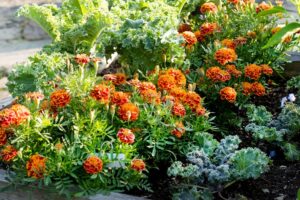
9. Marigolds
Marigolds appear on almost every companion planting list.
The evidence is more complicated than those lists make it sound.
There is good research showing benefits from marigolds in several vegetable systems, but the strongest recent cucurbit research I found was done with zucchini squash rather than cucumber.
In a two year field study, squash intercropped with African marigolds produced the highest marketable yields among the tested systems. The researchers were studying aphids, whiteflies, beneficial insects, and crop performance. [12]
Cucumbers and squash belong to the same plant family, but they are not the same crop.
So I would not claim that this study proves marigolds will increase cucumber yield.
What it does show is that marigolds can be useful plants in diversified cucurbit gardens.
My Practical View
I am comfortable growing marigolds around cucumber beds.
They stay fairly compact, flower for a long time, and bring more floral diversity into the garden.
I simply would not promise that one marigold will repel cucumber beetles or stop every pest.
That is not how companion planting works.
A Simple Companion Planting Plan for Cucumbers
You do not need all nine plants in one bed.
For most home gardens, that would create more crowding than benefit.
A simple layout works better.
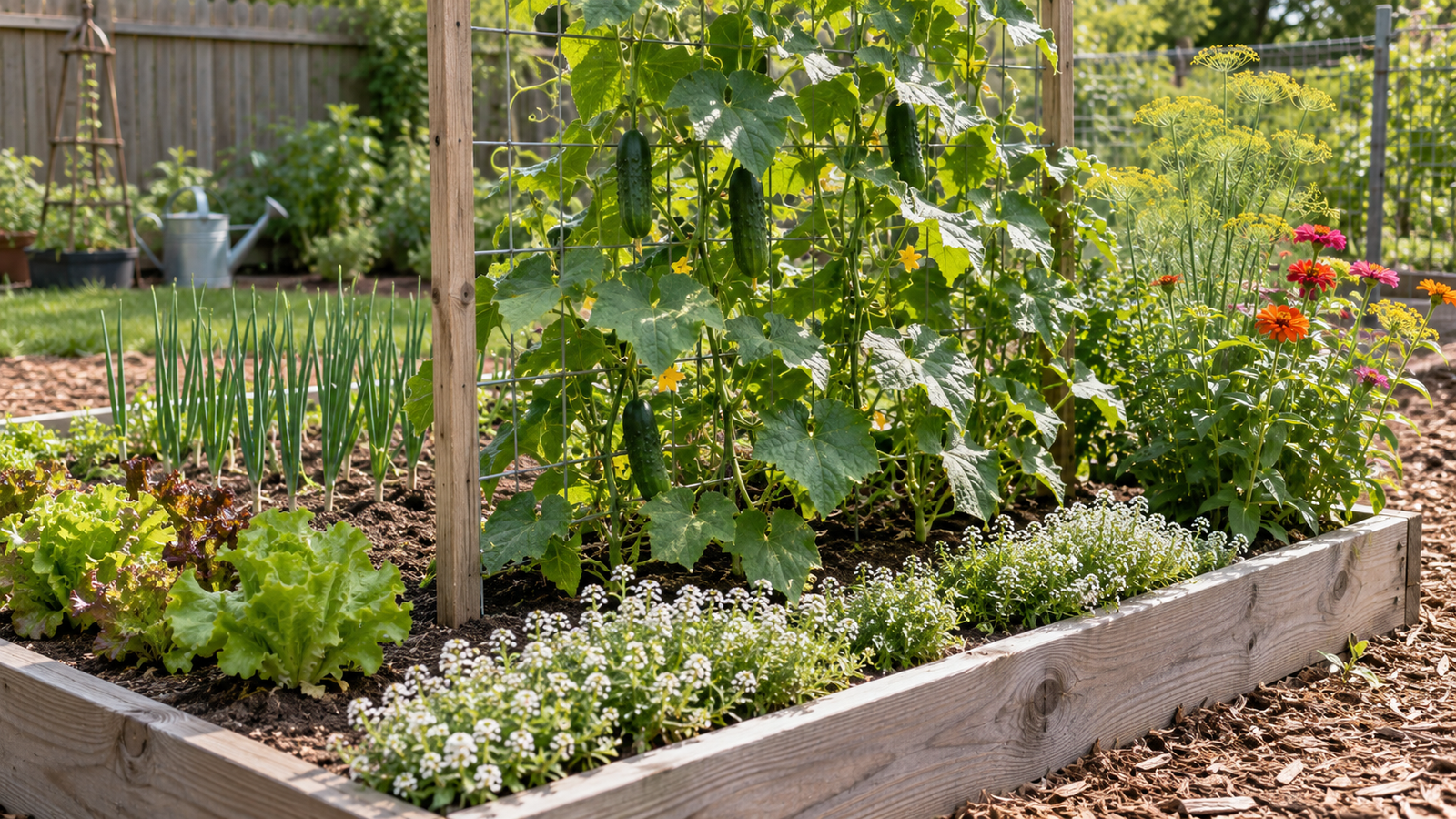
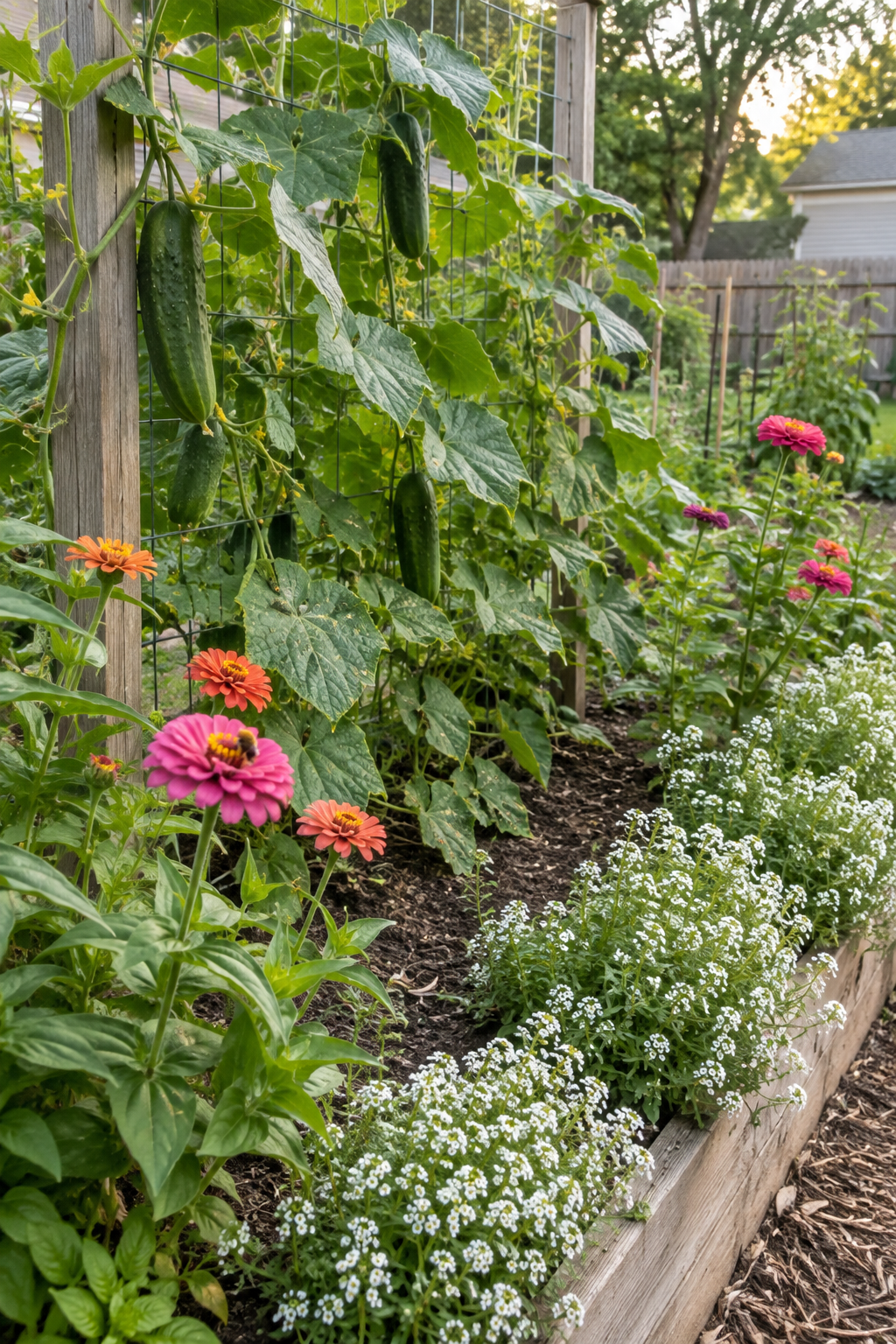
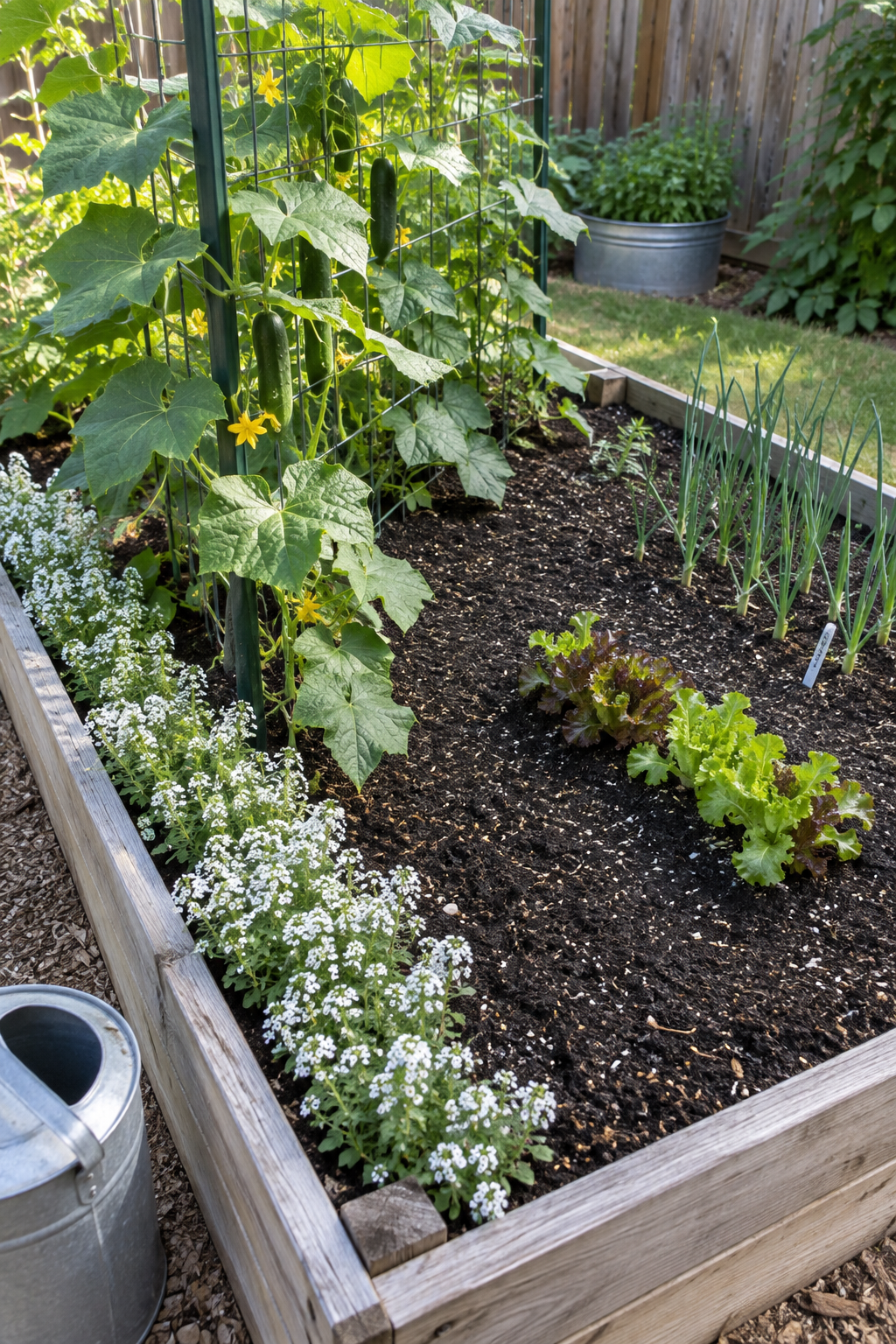
Put the cucumber vines on a trellis.
Plant sweet alyssum along the front edge.
Add a few onions or garlic where there is open soil.
Use lettuce early in the season and harvest it before the cucumber vines become large.
Place dill or zinnias near the outside of the bed where their flowers are easy for pollinators to find.
If you have a larger garden, use buckwheat or red clover outside the main cucumber row instead of squeezing them directly around the cucumber stems.
That is enough.
Companion planting should make the garden easier to manage, not harder.
Pollinators Matter More Than Most Gardeners Realize
When a cucumber plant looks healthy but produces very few good fruits, people often blame fertilizer.
Sometimes the real problem is pollination.
Most field and garden cucumbers need insects to move pollen between flowers.
Penn State reports that poor cucumber pollination can lead to lighter fruit, misshapen fruit, lower seed counts, and fruit abortion. [2]
University of Minnesota Extension also notes that cucumbers can become irregularly shaped when pollination is incomplete. [1]
This is why flowering plants around cucumbers make sense.
You are not feeding the cucumber with the flowers.
You are improving the neighborhood for the insects that help produce the crop.
Do Not Block Pollinators at Flowering Time
Row covers are useful for protecting young cucumber plants from cucumber beetles.
But once flowers open, ordinary cucumber varieties need access to pollinators.
University of Minnesota Extension recommends removing row covers when flowering begins unless you are growing a cucumber variety that does not require pollination. [1]
That small timing detail can make a big difference.
Do Not Overcrowd the Bed
This is where companion planting goes wrong most often.
Cucumber vines can cover a surprising amount of ground.
When gardeners add herbs, flowers, lettuce, onions, and several other companions without planning for mature size, the bed becomes packed.
Crowding creates competition for light, water, and nutrients.
It also makes it harder to:
See cucumber beetles
Reach the fruit
Water the soil properly
Remove damaged leaves
Keep vines on the trellis
Move through the garden without breaking stems
University of Minnesota Extension notes that cucurbit plants planted too closely compete for light and nutrients. [13]
Leave room.
An open patch of soil is not wasted space if the plants will fill it in a few weeks.
What About Nasturtiums?
Nasturtiums are extremely popular in companion planting articles.
They are attractive flowers and can be useful in a vegetable garden.
But I would be careful about repeating the common claim that they reliably protect cucumbers from beetles or aphids.
The evidence for that exact cucumber claim is not as strong as the evidence we have for red clover, flowering strips, or several of the other systems discussed in this guide.
I still like nasturtiums around gardens because they provide flowers and are easy to grow.
I simply would not make them the center of a cucumber pest control plan.
What About Radishes?
Radishes are another common recommendation.
They can fit physically around young cucumber plants because they mature quickly.
That makes them useful for early season space.
But claims that radishes reliably repel cucumber beetles are often repeated without strong evidence.
If you enjoy radishes, grow them.
Harvest them before cucumber vines fill the bed.
Think of the pairing as efficient use of space rather than guaranteed pest control.
What About Beans and Peas?
Beans and peas are often recommended because they can fix nitrogen through bacteria associated with their roots.
This fact is real.
The common companion planting explanation is often misleading.
A living bean plant does not simply pump free nitrogen into a cucumber plant growing beside it.
Much of the nitrogen remains in the legume until plant material and roots break down or nitrogen moves through the soil system.
Beans can still be grown in the same garden as cucumbers.
Just do not plant them with the expectation that they replace cucumber fertilizer during the season.
Also remember that pole beans and cucumbers can both become vigorous vines.
Trying to force both onto one small trellis can create a tangled mess.
The Best Companions Depend on Your Goal
There is no single best cucumber companion for every garden.
If you want more flowers close to the crop, start with sweet alyssum, zinnias, or dill.
If cucumber beetles and aphids are a regular problem, red clover has some of the strongest cucumber specific field evidence.
For larger gardens, buckwheat can provide a useful flowering border.
If you want another edible crop in the same space, onions, garlic, and early lettuce are practical options with research behind their use in cucumber intercropping systems.
If you simply want a colorful, diverse garden, marigolds are easy to include, but keep your expectations realistic.
You can also compare these ideas with our broader companion planting chart, while keeping in mind that research support varies from one pairing to another.
Frequently Asked Questions
What Is the Best Flower to Plant with Cucumbers?
Sweet alyssum is one of the best places to start.
It stays low, produces many small flowers, and has been directly studied in cucumber fields as an insectary plant.
Zinnias and dill are also useful choices when you want more flowers around the cucumber patch.
Do Cucumbers Need Companion Plants?
No.
Cucumbers can grow very well on their own.
Good soil, warm weather, regular water, enough space, pollination, and pest monitoring matter more than companion planting.
Companion plants are an extra tool.
Can I Plant Onions Next to Cucumbers?
Yes.
Research on greenhouse cucumber production found benefits from cucumber and onion intercropping, including higher cucumber productivity compared with cucumber monoculture in the tested system.
Leave enough room for both crops instead of packing onions tightly around the cucumber crown.
Can I Plant Garlic with Cucumbers?
Yes.
Garlic and cucumber have also been studied together, with positive effects on cucumber productivity and aspects of the soil environment in greenhouse research.
Garlic is especially convenient because it may be ready to harvest before cucumber vines reach their largest size.
Can Lettuce Grow with Cucumbers?
Yes.
Lettuce and cucumber can share space successfully when planting time and density are managed well.
For a home gardener, the easiest method is to grow lettuce while cucumber plants are still small and harvest it before the cucumber canopy becomes dense.
Do Marigolds Keep Cucumber Beetles Away?
I would not promise that.
Marigolds have useful research behind them in several crop systems, including related cucurbit crops, but evidence that ordinary marigold planting reliably stops cucumber beetles is limited.
Use marigolds for floral diversity rather than treating them as guaranteed beetle control.
Does Dill Help Cucumbers?
Flowering dill attracts pollinators and beneficial insects, and Penn State Extension lists cucumber among its traditional companion crops.
Its biggest practical value near cucumbers is the extra floral resource it provides.
Should Cucumbers and Companion Plants Share the Same Trellis?
Usually not.
Cucumber vines can fill a trellis quickly.
Adding another vigorous vine such as pole beans can create too much competition and make harvesting difficult.
Keep the cucumber trellis simple unless you have plenty of space.
How Close Should Companion Plants Be to Cucumbers?
There is no single distance that works for every plant.
Low plants such as alyssum and lettuce can grow fairly close to the bed edge.
Large flowering plants such as zinnias or buckwheat should be farther away so they do not shade or crowd the vines.
Always plan for mature plant size.
Final Thoughts
The best cucumber companion planting plan is usually a simple one.
Start with the cucumber itself.
Give it warm soil, regular water, a trellis, enough room, and access to pollinators.
Then add plants that solve a real problem.
Sweet alyssum, zinnias, and dill can add flowers around the crop.
Red clover can change the habitat around cucumbers and has good field research behind it for reducing some pest pressure.
Buckwheat can support natural enemies in a larger garden.
Onions, garlic, and lettuce can help you get more useful production from the same growing area when they are managed carefully.
You do not need a dozen companions around every cucumber plant.
Choose two or three that fit your garden and give everything enough room to grow.
That is more useful than following a long list of supposed plant friendships.
If tomatoes are also part of your garden, see our guide to the best companion plants for tomatoes to continue building the same planting system across your vegetable beds.
Lopez, M., and Liburd, O. E. Effects of intercropping marigold, cowpea and an insecticidal soap on whiteflies and aphids in organic squash. Journal of Applied Entomology. https://onlinelibrary.wiley.com/doi/10.1111/jen.13141