Growing tomatoes becomes much easier when the plants around them have a useful job.
Some plants can make it harder for certain pests to find your tomatoes. Others bring in insects that feed on aphids and other garden pests. A few help cover bare soil, reduce weeds, or simply make better use of the space in your garden.
But companion planting is often oversold.
Putting two plants next to each other does not automatically make either one grow better. There is also no companion plant that can protect tomatoes from every pest or disease.
Research on mixed planting shows that plant choice matters, but so do spacing, timing, plant density, water, and the way the garden is arranged. In other words, companion planting works best when there is a clear reason for each plant to be there.
This guide focuses on tomato companions that have either direct research behind them or a practical benefit that makes sense in a home vegetable garden.
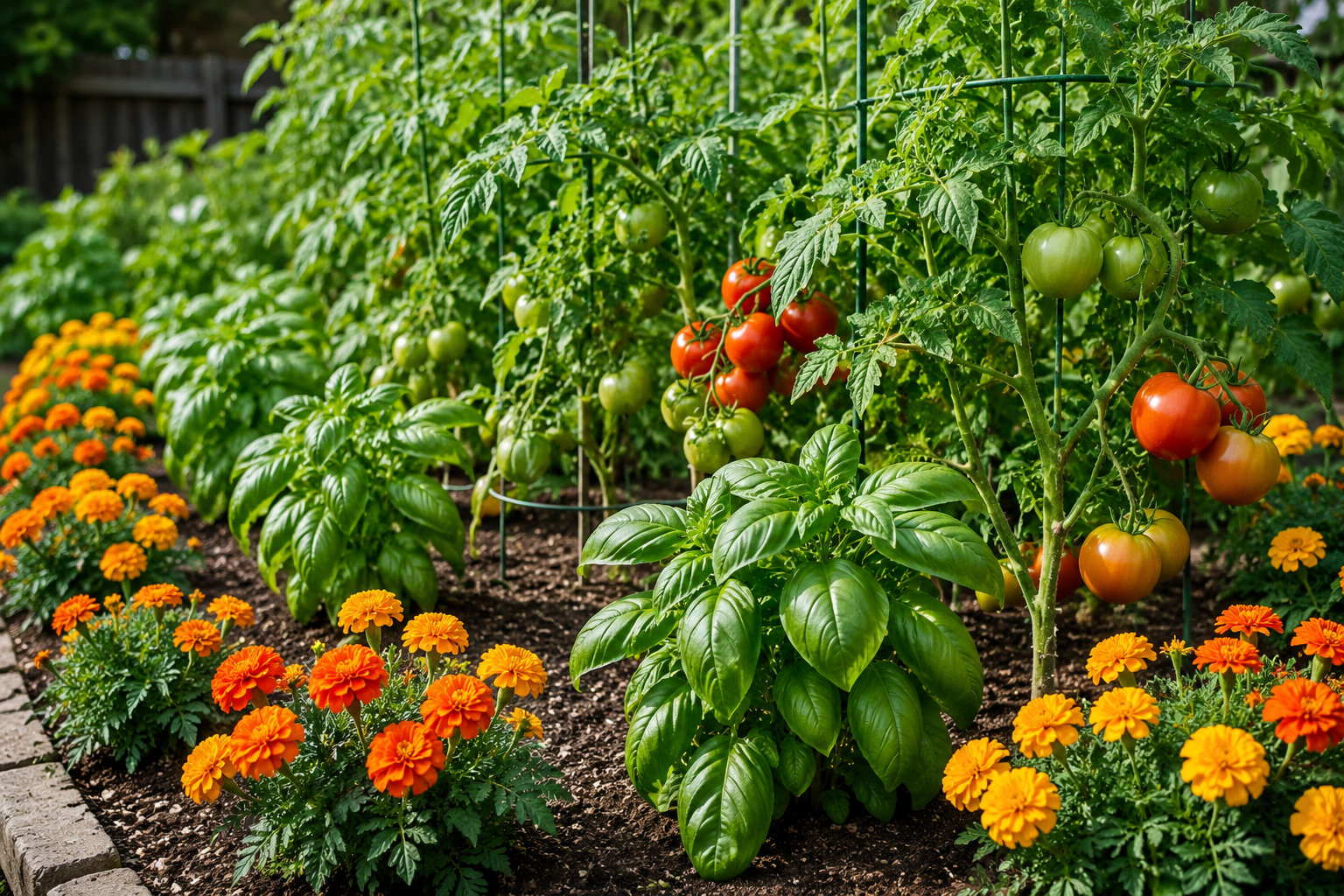
What Makes a Good Companion Plant for Tomatoes?
I look for four things when choosing plants to grow around tomatoes.
A useful companion should do at least one of these jobs:
- Help reduce pressure from a known tomato pest
- Provide food or shelter for beneficial insects
- Cover open soil without badly competing with tomato roots
- Make good use of space while the tomatoes are still small
That is a more useful way to think about companion planting than simply memorizing charts.
A plant does not need to magically improve tomato flavor or send nutrients directly into the tomato roots to be useful.
Sometimes the biggest benefit is simply having more plant diversity around the crop.
1. French Marigolds
If I had to choose one flower to grow around tomatoes, French marigold would be near the top of the list.
There is good research behind this pairing.
A large greenhouse study tested French marigolds grown alongside tomato plants and found that the marigolds slowed the development of glasshouse whitefly populations. Researchers found that compounds released into the air by the marigolds, especially limonene, played an important role in making the area around the tomatoes less attractive to whiteflies.
There is an important detail here.
The marigolds were most useful when they were grown with the tomatoes from the beginning.
Adding marigolds after a heavy whitefly infestation had already developed was much less effective.
That matches what I would recommend in a home garden. Companion planting is mostly a preventive tool. It should not be treated like a rescue treatment after pests have taken over.
How to Grow Marigolds with Tomatoes
Plant French marigolds around the outside of the tomato bed or in open spaces between tomato plants.
Give both plants enough room to reach their normal size.
Do not pack marigolds tightly around the tomato stem. Tomatoes need airflow around their lower leaves, especially in humid weather.
French marigolds are also easy to maintain. They enjoy the same sunny conditions that tomatoes need and keep producing flowers for a long part of the growing season.
What About Marigolds and Nematodes?
There is research showing that certain French marigold varieties can help reduce some root knot nematodes.
But this benefit is often misunderstood.
In one field study, marigolds were grown before tomatoes. Tomatoes planted afterward had less root damage from nematodes, and some marigold treatments also improved tomato yield.
That is not the same as planting one marigold beside an infected tomato and expecting the nematodes to disappear.
For serious nematode problems, marigolds work better as part of a planned crop management system.
2. Basil
Tomatoes and basil belong together in the kitchen, but there are also good reasons to put them together in the garden.
Basil has been studied as a companion crop for tomatoes, especially for insect management.
In field research involving tomatoes and basil, tomatoes grown with basil had lower whitefly pressure. Planting basil between tomato rows was more effective than putting basil only around the outside of the crop.
University of Minnesota Extension also notes research showing that basil and marigolds can reduce some insect pressure on tomatoes.
Penn State Extension lists basil as a research supported tomato companion because its presence can make it harder for pests such as thrips and certain moths to locate tomato plants or lay eggs on them.
Where to Plant Basil
Basil works well in open spaces between tomato plants or along the front of a tomato bed.
The main thing is to avoid crowding.
A mature tomato plant can develop a large root system and heavy canopy. Basil also grows quickly in rich summer soil.
Give both plants enough space for air to move between their leaves.
If you harvest basil regularly, it usually stays compact enough to work well beside tomatoes.
Does Basil Make Tomatoes Taste Better?
This is one of the most repeated companion planting claims.
I would not promise it.
There is much better evidence for basil as part of pest management and crop diversity than there is for the claim that basil noticeably improves tomato flavor.
Grow basil because it is useful, easy to harvest, and works well in the same summer conditions as tomatoes.
Better tasting tomatoes should be considered a bonus if you notice one, not a guaranteed result.
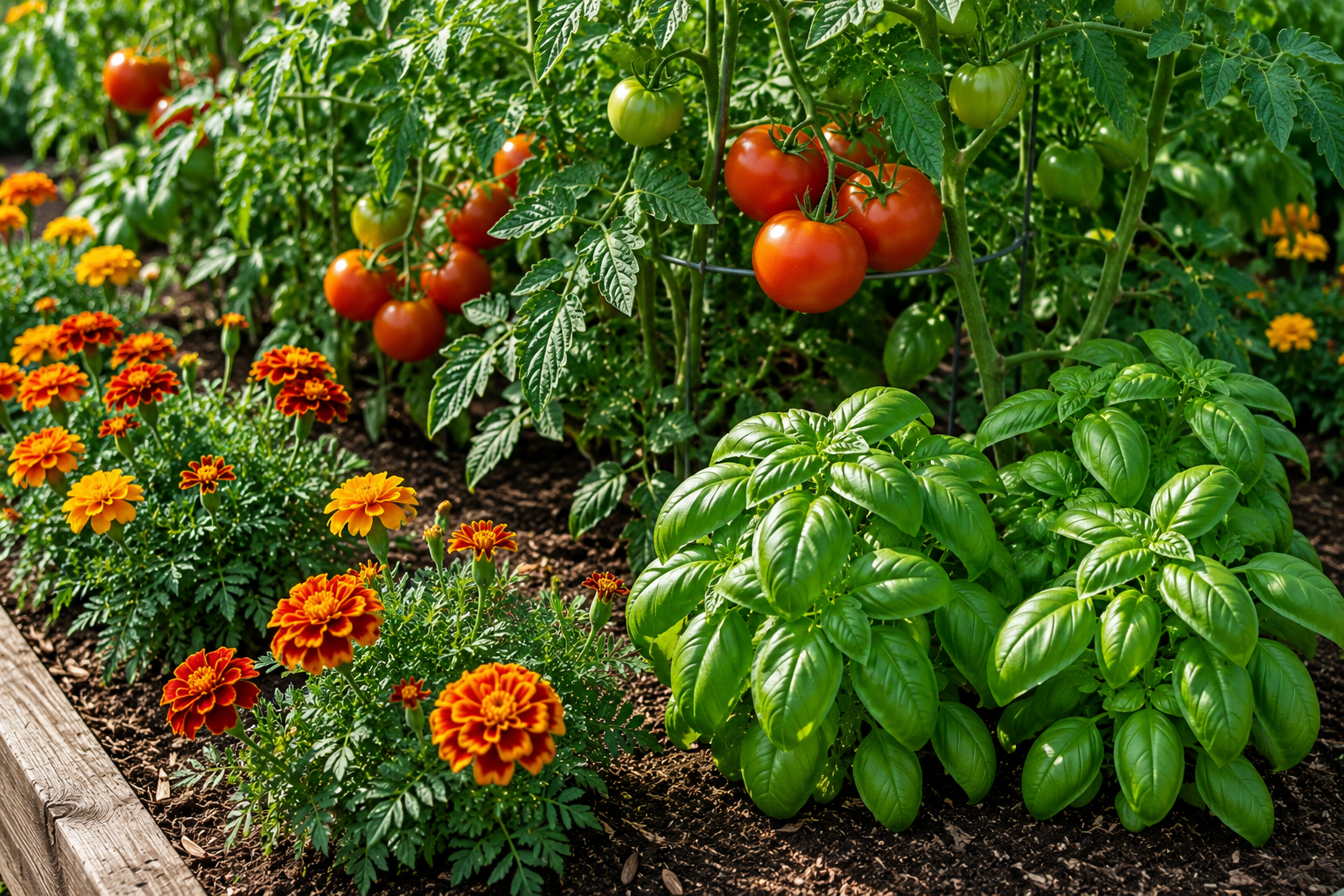
3. Sweet Alyssum
Sweet alyssum does something different from basil and marigolds.
Instead of mainly making the area less attractive to pests, its small flowers provide food for useful insects.
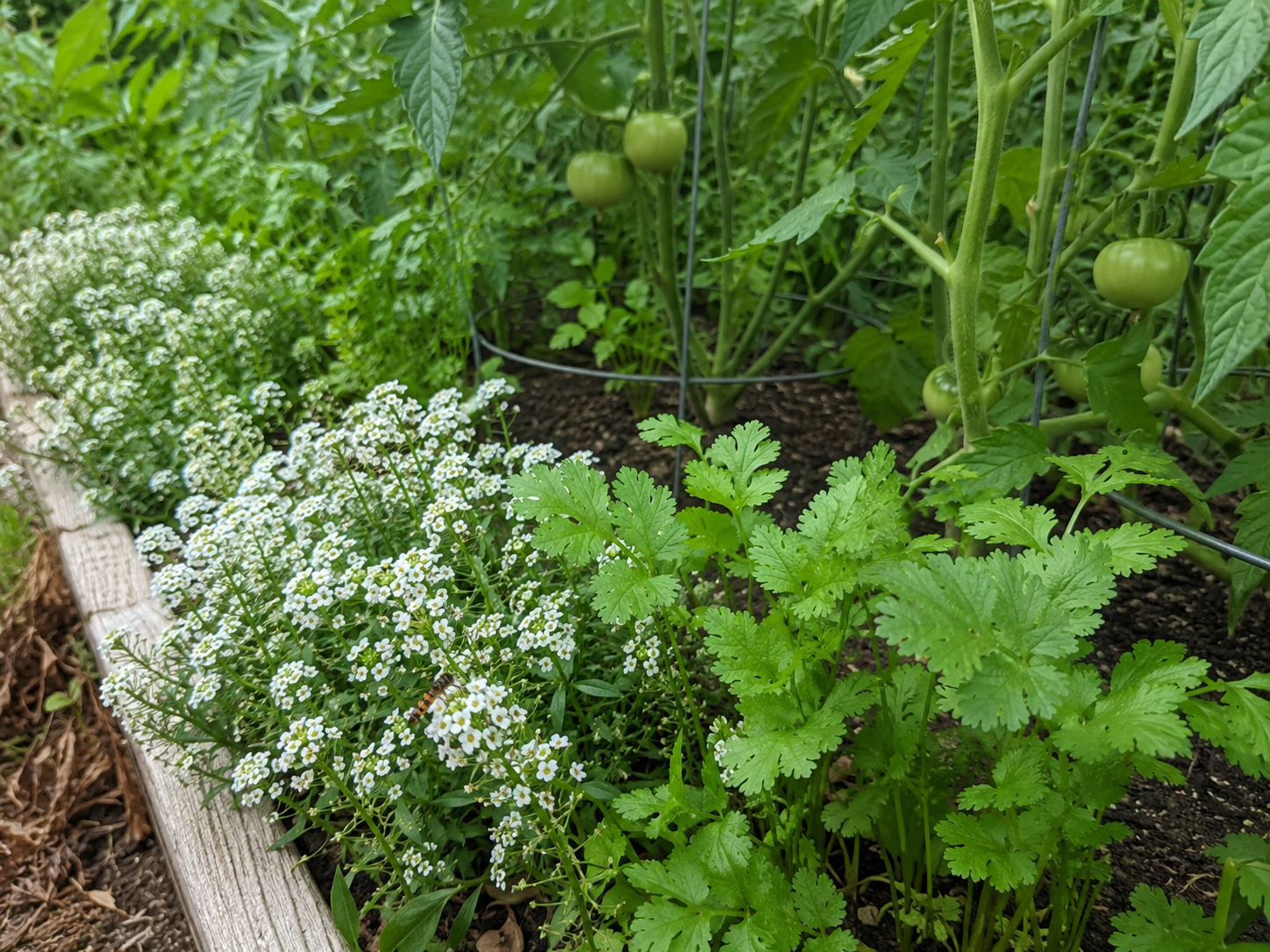
Sweet alyssum produces clusters of tiny flowers that are easy for many beneficial insects to feed from.
Researchers have shown that alyssum flowers can support hoverflies. Hoverfly larvae are useful predators that eat aphids. In field research, access to sweet alyssum increased hoverfly egg production and resulted in fewer aphids on the crop being studied.
There is also tomato specific experience from the University of Florida.
Sweet alyssum growing around tomato production areas attracted lady beetles, hoverflies, lacewings, several kinds of wasps, and other beneficial insects associated with natural pest control.
That makes alyssum especially useful if you want to create a garden where beneficial insects can stay instead of simply passing through.
Where to Plant Sweet Alyssum
I prefer it along the outside of the tomato bed.
It stays fairly low and can fill spaces that would otherwise remain bare.
You can also place small groups between tomatoes if there is enough room.
The goal is not to surround every tomato stem with flowers. A few flowering patches around the bed can provide food for beneficial insects without making watering and harvesting difficult.
4. Cilantro
Most people think of cilantro as a kitchen herb, but it becomes especially useful in the garden when you allow some of it to flower.
Cilantro is the leafy stage of the coriander plant.
Once the plant begins flowering, its small blooms can provide food and habitat for useful insects.
Research has found that coriander can attract a lady beetle species that feeds on aphids. Even more interesting, coriander increased the attraction of these beetles when it was combined with tomato plants already carrying aphids.
The adult beetles also lived longer when they had access to coriander flowers.
That gives cilantro a clear job around tomatoes.
You are not planting it because it feeds the tomato plant. You are planting it because it helps make the garden more welcoming to insects that eat pests.
Let Some Cilantro Flower
If your only goal is harvesting cilantro leaves, flowering can seem like a problem.
For companion planting, it is useful.
I normally recommend harvesting some plants and leaving others alone so they can flower.
Cilantro often flowers quickly when hot weather arrives anyway, so this is an easy way to turn an old herb plant into an insectary plant.
5. Thyme
Thyme is another useful herb to consider around tomatoes.
Penn State Extension includes thyme and basil among herbs with research supported value around tomatoes, particularly for reducing the egg laying behavior of some pest moths.
Thyme also flowers when allowed to mature, and those small flowers can be useful to beneficial insects.
There is another practical reason I like thyme near tomatoes.
It stays much lower than a tomato plant.
That means it can occupy part of the lower garden space without creating the same amount of shade or competition that a large companion plant might cause.
Do Not Keep the Soil Constantly Wet for Thyme
Tomatoes need regular moisture, especially when they are producing fruit.
Established thyme prefers somewhat drier conditions.
For that reason, I would place thyme toward the edge of the tomato bed rather than directly beside the main irrigation point.
It is a good example of why companion planting still requires basic plant care.
Two plants can be useful neighbors without having exactly the same needs.
6. Lettuce
Lettuce does not need to repel an insect to be a useful tomato companion.
It can help you use garden space more efficiently.
Tomatoes are usually small when they first go into the garden. They may take weeks before their leaves fill the bed.
Lettuce grows much faster.
University of Minnesota Extension recommends using fast growing crops such as lettuce and spinach around slower crops such as tomatoes as a way to use garden space more efficiently.
You can grow lettuce while the tomatoes are still young, harvest much of it, and then allow the tomatoes to take over the space.
Later in the season, the tomato canopy can also provide some shade to lettuce during warm weather.
Why This Pairing Works
This is not pest control.
It is good garden planning.
The lettuce uses open ground early in the season without needing to remain there after the tomato plants become large.
For gardeners with small raised beds, this kind of companion planting can be more useful than planting something simply because an old chart says the plants are friends.
7. Hairy Vetch
Hairy vetch is different from the other plants in this guide.
I would usually grow it before the tomatoes rather than directly beside them during summer.
It is a cover crop.
Hairy vetch can be planted during the cooler part of the year and later cut down so the plant material remains on the soil as mulch.
USDA researchers have spent years studying this system with tomatoes.
Hairy vetch can add organic matter, help protect the soil, reduce water loss, suppress some weeds, and slowly return nutrients to the soil as the plant material breaks down.
In USDA tomato trials, several tomato varieties produced higher yields in hairy vetch mulch than in the conventional comparison system. Disease severity was also lower in some trials.
How a Home Gardener Can Use It
Grow hairy vetch as a cover crop when the tomato bed is not being used.
Then cut it before planting tomatoes and leave much of the plant material on the soil surface.
Plant the tomatoes through the remaining mulch.
This is a more advanced type of companion planting, but it can be very useful for gardeners trying to build healthier soil and rely less on purchased inputs.
Do not expect hairy vetch to instantly feed a tomato plant.
Nutrients become available as the plant material breaks down.
8. Clover
Low growing clover can work as a living mulch between tomato plants or tomato rows.
Its main value is soil cover.
Bare soil gives weeds plenty of room to grow. A controlled clover cover can occupy some of that space instead.
Research with subterranean clover found strong weed suppression while tomato yields were not significantly reduced in the tested system.
Other research with clover living mulch has produced more mixed results, especially when the clover competes too strongly with the crop.
That is why I consider clover useful, but not foolproof.
Clover Is Better for Larger Gardens
I would not put a thick clover carpet around a young tomato plant in a small container.
In a larger garden, clover can work between widely spaced rows where you can mow or trim it if necessary.
Remember that living mulch is still alive.
It uses water and nutrients.
If it becomes too aggressive, it stops being a companion and starts becoming competition.
The Best Way to Arrange Companion Plants Around Tomatoes
Do not try to squeeze every companion plant in this article around one tomato.
Choose plants based on what you actually need.
If whiteflies are a common problem, I would start with French marigolds and basil.
If aphids appear regularly, I would make room for flowering alyssum and cilantro so beneficial insects have a reason to stay nearby.
If you have a small garden, use quick crops such as lettuce while the tomatoes are young.
If soil improvement is your main goal, a cover crop such as hairy vetch may give you more value than another summer flower.
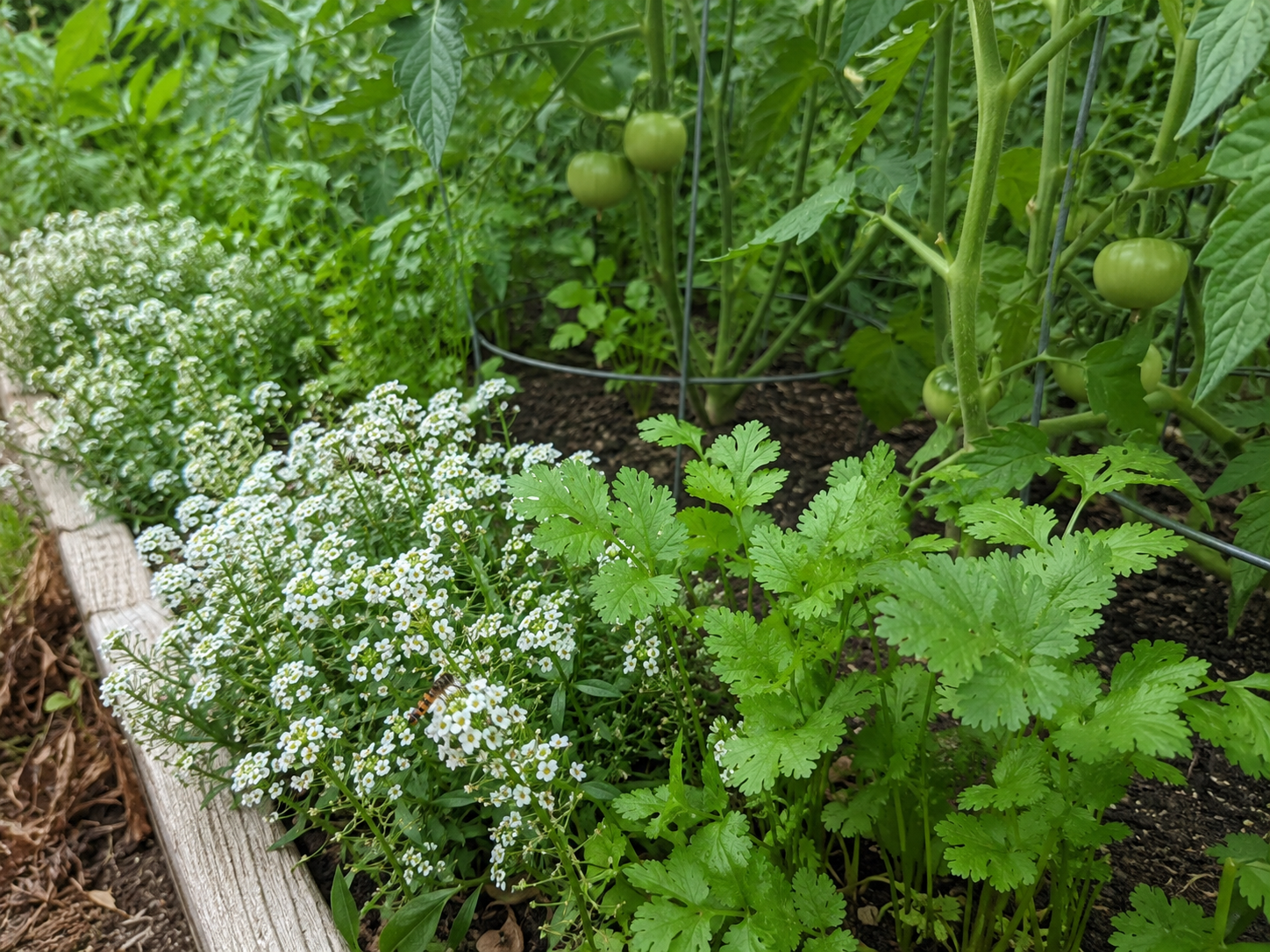
A simple tomato bed might contain tomatoes as the main crop, basil in some of the open spaces, marigolds around the outside, and a patch of sweet alyssum near the edge.
That is enough.
More plants do not automatically mean better companion planting.
Do Not Overcrowd Your Tomatoes
This is probably the most common mistake beginners make after learning about companion planting.
They see a list of ten useful plants and try to fit all ten around the tomatoes.
The result is often a crowded bed.
Tomatoes need sunlight, water, nutrients, and air movement.
Dense growth around the base can make watering harder and can keep leaves wet longer after rain or irrigation.
That can become a bigger problem than whatever benefit the companion plants were supposed to provide.
Always plan for the mature size of each plant.
The garden may look empty when everything is newly planted. Give it time.
By midsummer, the same space can become completely full.
Companion Plants Are Not a Replacement for Tomato Care
A marigold cannot fix poor soil.
Basil cannot save a tomato plant that receives too little sun.
Sweet alyssum cannot make up for irregular watering.
Good tomato care still comes first.
Your tomatoes need plenty of sun, suitable soil, regular moisture, enough room, and support from a cage, stake, or trellis.
Companion plants should support that system, not replace it.
What About Garlic, Nasturtiums, Borage, and Other Popular Companions?
You will find long lists online claiming that many plants protect tomatoes.
Some may be perfectly fine plants to grow nearby.
The problem is that the evidence behind many specific claims is limited or inconsistent.
For example, one experiment on tomatoes and garlic found lower numbers of one tomato pest but much higher numbers of certain mites and thrips in the garlic treatment.
That is a good reminder that nature rarely gives us a simple answer.
A plant can affect several insects in different ways.
Nasturtium also appeared in tomato companion planting research where mixed nonhost plants helped reduce whitefly pressure, but that experiment did not prove that nasturtium alone was responsible for the effect.
I am comfortable growing plants like nasturtium around a vegetable garden.
I am simply careful about promising a specific tomato benefit that has not been clearly demonstrated.
Common Companion Planting Mistakes
Expecting One Plant to Repel Every Pest
No companion plant does that.
Choose companions based on the pests and problems that actually occur in your garden.
Planting Companions Too Late
French marigold research showed a much better preventive effect when marigolds were present from early in the tomato crop.
Adding them after whiteflies had already reached high numbers had little effect.
Forgetting About Competition
Every living plant needs water, nutrients, sunlight, and physical space.
Even a useful companion can hurt tomatoes when planted too densely.
Believing Every Companion Planting Chart
Many charts mix research, gardening tradition, personal experience, and repeated internet claims.
Some combinations work well.
Others have never been tested properly.
University Extension sources also caution that many companion planting claims have been repeated for years without strong research behind them.
What Is the Best Companion Plant for Tomatoes?
There is no single best plant for every garden.
For pest protection, French marigold and basil have some of the clearest tomato specific research behind them.
For attracting beneficial insects, sweet alyssum and flowering cilantro are excellent choices.
For using space efficiently, lettuce is simple and practical.
For soil management, hairy vetch can be extremely useful when grown as a cover crop before tomatoes.
If you are new to companion planting, I would start small.
Grow tomatoes with basil and French marigolds, then add a patch of sweet alyssum nearby.
That gives you herbs, flowers, beneficial insect habitat, and greater plant diversity without turning your tomato bed into a crowded experiment.
Frequently Asked Questions
Can I Plant Basil Right Next to Tomatoes?
Yes, basil and tomatoes can grow in the same bed.
Leave enough room for both plants to mature. Do not crowd several basil plants tightly against the tomato stem.
Do Marigolds Really Help Tomato Plants?
There is good evidence that French marigolds can reduce glasshouse whitefly pressure when grown with tomatoes from early in the season. Research also shows that certain marigold varieties can help manage some root knot nematodes when used as a crop before tomatoes.
How Many Companion Plants Should I Grow Around Each Tomato?
There is no scientific number that works in every garden.
The right amount depends on tomato variety, bed size, companion plant size, climate, and irrigation.
It is better to leave some open space than to overcrowd the bed.
Can Companion Planting Stop Tomato Hornworms?
Some herbs can affect moth behavior or help attract insects that attack caterpillars, but companion planting should not be your only hornworm control.
Inspect tomato plants regularly and remove large pests when you find them.
Does Companion Planting Improve Tomato Flavor?
Claims that particular companion plants make tomatoes taste better are not well proven.
Tomato variety, sunlight, plant health, ripeness, water, and growing conditions have a much clearer effect on fruit quality.
Can I Use Companion Plants with Tomatoes in Containers?
Yes, but containers have limited root space.
Instead of putting several plants into one pot, it is often easier to grow the tomato in its own large container and place pots of basil, marigolds, or sweet alyssum nearby.
You still get plant diversity without forcing everything to compete inside one container.
Is Companion Planting Worth Doing?
Yes, when you use it for a clear reason.
Research supports several forms of mixed planting for pest management, beneficial insect habitat, weed control, soil protection, and efficient use of garden space.
Just do not expect companion plants to replace basic tomato care.
Final Thoughts
The best tomato companion garden is not the one with the most different plants.
It is the one where every plant has a purpose and enough room to grow.
Start with a few companions that fit the problems you actually have. Basil and French marigolds are good choices for many gardens. Sweet alyssum and flowering cilantro can help bring beneficial insects into the bed. Lettuce can make good use of open soil early in the season, while cover crops such as hairy vetch can help improve the soil before tomatoes are planted.
Keep the tomato plants themselves as the priority.
Give them enough sun, water, space, and airflow. Then use companion plants to support the garden around them.
That approach is simple, practical, and much more useful than trying to follow a long list of supposed plant friendships.
References
- West Virginia University Research Repository. Research on companion planting and crop interactions.
https://researchrepository.wvu.edu/etd/2105/ - Conboy, N. J. A. et al. Companion planting with French marigolds protects tomato plants from glasshouse whiteflies through the emission of airborne limonene. PLOS ONE.
https://journals.plos.org/plosone/article?id=10.1371/journal.pone.0213071 - PubMed. Research on French marigolds for root knot nematode management in tomato production.
https://pubmed.ncbi.nlm.nih.gov/30818673/ - MDPI Agronomy. Research on basil as a companion crop in tomato production and whitefly management.
https://www.mdpi.com/2073-4395/6/3/42 - University of Minnesota Extension. Companion planting in home gardens.
https://extension.umn.edu/garden-and-home/yard-and-garden/gardening-in-minnesota/companion-planting-in-home-gardens - Penn State Extension. Herbs make good plant partners and companions.
https://extension.psu.edu/herbs-make-good-plant-partners-and-companions - Wiley Online Library. Research on sweet alyssum, hoverflies, and aphid control.
https://onlinelibrary.wiley.com/doi/10.1111/j.1570-7458.2011.01174.x - University of Florida IFAS Extension. Sweet alyssum and beneficial insects in tomato production.
https://ask.ifas.ufl.edu/publication/HS1486 - ScienceDirect. Research on coriander, tomato plants, and aphid feeding lady beetles.
https://www.sciencedirect.com/science/article/pii/S1049964415300323 - United States Department of Agriculture Agricultural Research Service. Sustainable tomato production using hairy vetch mulch.
https://www.ars.usda.gov/ARSUserFiles/oc/np/SustainableTomatoes2007/TomatoPub.pdf - United States Department of Agriculture Agricultural Research Service. Tomato production and disease response in hairy vetch mulch systems.
https://www.ars.usda.gov/research/publications/publication/?seqNo115=124238 - ScienceDirect. Research on subterranean clover living mulch and weed suppression in tomato production.
https://www.sciencedirect.com/science/article/abs/pii/016788099290096T - University of New Hampshire Scholars Repository. Research on clover living mulch and vegetable crop competition.
https://scholars.unh.edu/thesis/296/ - Egyptian Academic Journal of Biological Sciences. Research on garlic intercropping and arthropod populations in tomato crops.
https://eajbsa.journals.ekb.eg/article_12768.html