Cucumbers are generous plants when they have enough sun, steady moisture, room to climb, and good pollination.
They can also become difficult very quickly when the bed gets crowded.
That is why I do not like using the phrase “bad companion” without explaining what the actual problem is.
Some plants share important cucumber pests. Some make crop rotation harder. Some simply take over too much space. Others prefer soil conditions that are almost the opposite of what cucumbers need.
And then there are plants that appear on bad companion lists even though there is very little evidence that they actually harm cucumbers.
This guide separates those situations.
If you are looking for the plants that are useful around cucumbers, read our guide to the best companion plants for cucumbers. It covers sweet alyssum, zinnias, dill, red clover, onions, garlic, lettuce, and other practical choices.
The Short Answer
These are the seven plants or plant groups I would think twice about putting directly into a cucumber bed:
| Plant | Main concern | My recommendation |
|---|---|---|
| Irish potatoes | Competition, digging disturbance, and weak companion compatibility | Keep in another bed |
| Pumpkins and winter squash | Shared cucumber beetles, shared crop family, and large vines | Separate in small gardens |
| Muskmelons and cantaloupes | Strong bacterial wilt risk and shared cucumber beetles | Use another bed when pest pressure is high |
| Zucchini and summer squash | Shared beetle pressure, crowding, and difficult rotation | Give each crop enough space |
| Sage | Different watering and soil preferences | Grow nearby, not in the wet cucumber root zone |
| Rosemary | Prefers drier, faster draining soil | Keep in its own area or container |
| Mint | Aggressive underground spreading | Grow in a container |
This list needs one important explanation.
Only a few of these are plants I would call truly troublesome cucumber neighbors.
Others are simply awkward plants to combine in the same small bed.
That difference matters because companion planting advice often turns practical gardening problems into mysterious claims about plants helping or hurting each other.
Our article about companion planting myths and facts explains why many popular charts should be treated as a starting point rather than a set of strict rules.
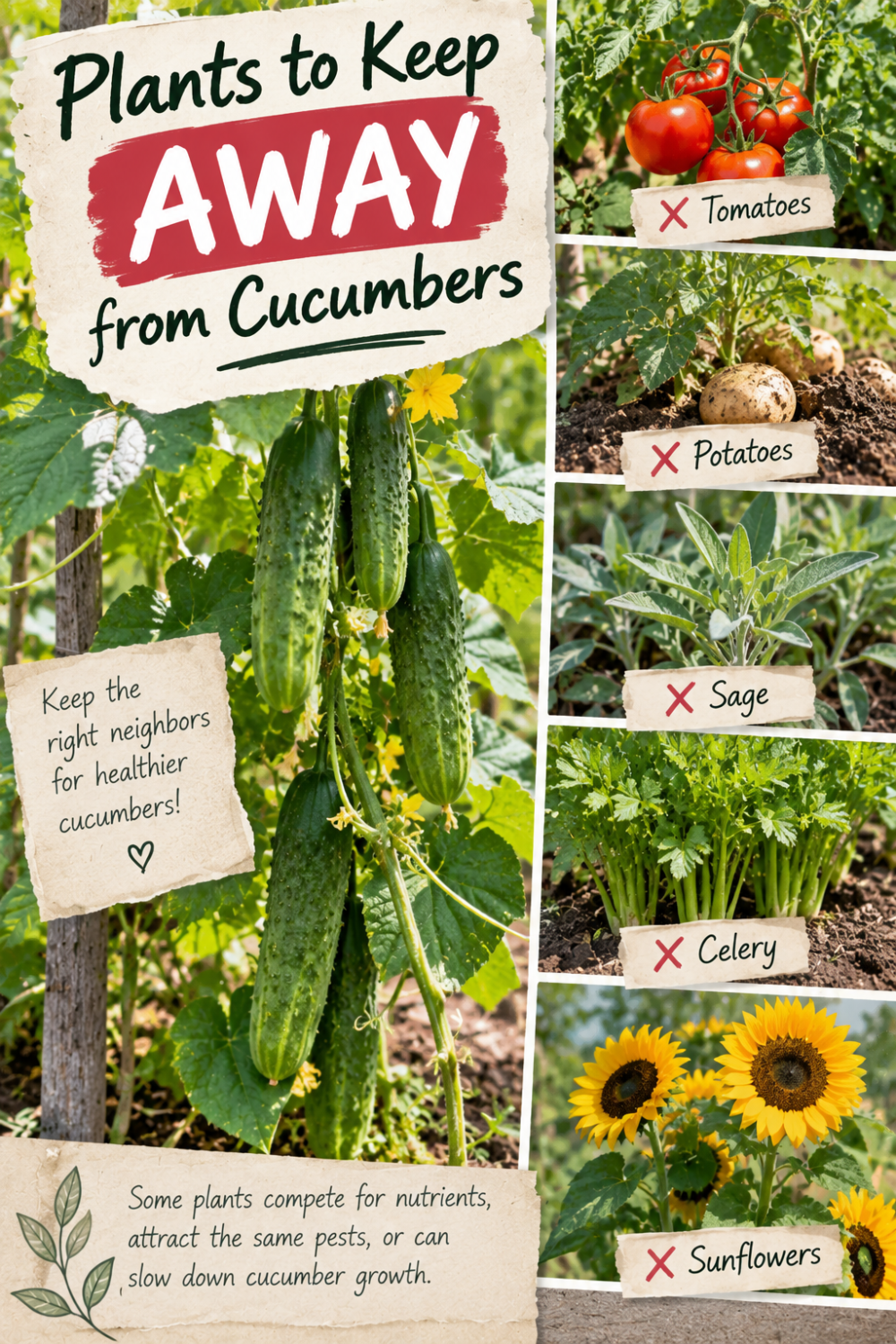
1. Irish Potatoes
Potatoes are one of the few crops that appear repeatedly on Extension companion planting charts as a poor partner for cucumbers.
Virginia Cooperative Extension, West Virginia University Extension, Oklahoma State University, and University of California Master Gardener companion planting resources all list Irish potatoes as incompatible with cucumbers.[1][2][3]
I would still be careful about the explanation.
There is much less direct experimental research on cucumber and potato competition than the charts make it sound.
So I would not tell a beginner that potato roots somehow poison cucumber roots.
The practical reasons for separating them are easier to defend.
Potatoes Need to Be Dug Up
A cucumber plant develops a wide root system close to the soil surface.
Potatoes are harvested by digging through the soil.
If potatoes are growing close to an established cucumber plant, harvest can disturb cucumber roots at exactly the time the cucumber vine is producing heavily.
Both Crops Can Fill the Root Zone Quickly
Potatoes need good fertility and regular moisture while tubers are developing.
Cucumbers also grow quickly and need consistent access to water.
In a small raised bed, there is no good reason to make these two productive crops fight for the same limited root area when both are easy to grow separately.
My Recommendation
Keep potatoes in another bed, grow bag, or potato container.
Use the cucumber bed for smaller companions that do not require major soil disturbance at harvest.
Lettuce, sweet alyssum, onions, and garlic are much easier plants to work around an established cucumber vine.
2. Pumpkins and Winter Squash
Pumpkins and winter squash are not chemically incompatible with cucumbers.
The problem is that they belong to the same crop family and share several important insect pests.
Striped cucumber beetles feed on cucurbit crops and can spread bacterial wilt. Penn State Extension notes that the beetles attack cucumbers, zucchini, cantaloupes, pumpkins, and other cucurbits.[4]
University of Minnesota Extension also explains that cucumber beetles feed on cucurbits and that cucumbers are especially vulnerable because bacterial wilt can kill infected vines.[5]
Grouping Cucurbits Creates One Large Target
If you fill one small area with cucumbers, pumpkins, and squash, you are putting several preferred cucumber beetle hosts together.
That does not guarantee a beetle problem.
But if beetles arrive, they have plenty of suitable plants in one place.
It also becomes harder to separate crop families when you rotate the garden the following year.
Penn State recommends crop rotation as part of cucumber beetle management and suggests locating new cucurbit plantings away from the previous year’s cucurbit area when possible.[4]
The Vines Are an Even Bigger Problem in Small Beds
A pumpkin vine can travel far beyond the space where it was planted.
A cucumber vine also wants room.
Put both in a small raised bed and you can quickly lose access to the soil, irrigation line, cucumber fruit, and lower leaves.
I prefer to trellis cucumbers and give pumpkins a separate area where they can spread.
3. Muskmelons and Cantaloupes
Cucumbers and muskmelons share one particularly important problem: bacterial wilt.
University of Minnesota Extension states that bacterial wilt can cause severe losses in cucumbers and muskmelons. The bacteria are spread by striped and spotted cucumber beetles.[6]
That makes this combination different from two unrelated crops that simply need a lot of fertilizer.
Here, the same insect can move between susceptible plants and spread the same serious disease.
Bacterial Wilt Cannot Be Cured Once the Plant Is Infected
This is why I take the problem seriously.
Once a cucumber or melon plant develops bacterial wilt, spraying the plant will not cure it.
University of Minnesota recommends removing infected plants and focusing management on cucumber beetles.[6]
University of Maryland Extension gives similar advice and emphasizes controlling cucumber beetles early in the season to reduce infection risk.[7]
Do Cucumbers and Melons Have to Be Far Apart?
No.
Large commercial fields can contain different cucurbit crops, and home gardeners may grow them in the same garden.
I simply would not pack them together in one small bed if cucumber beetles and bacterial wilt are common problems in your area.
Separating the crops makes monitoring easier and gives you more flexibility with rotation.
4. Zucchini and Summer Squash
Zucchini is another cucurbit.
It shares cucumber beetles with cucumbers, although bacterial wilt tends to be more serious in cucumbers and muskmelons than in squash.[6]
The bigger problem in a backyard raised bed is usually physical space.
A Mature Zucchini Plant Is Much Wider Than It Looks in Spring
One small transplant can become a broad plant that covers a large part of the bed.
If that plant is placed directly beside a cucumber trellis, its leaves may cover the soil around the cucumber stem and make it harder to inspect the plant.
You may also end up watering, harvesting, and walking through dense foliage every time you need a cucumber.
Shared Pests Make Monitoring More Important
Penn State explains that cucumber beetles feed on cucurbit crops and can spread bacterial wilt.[4]
If you grow cucumber and zucchini in the same general garden, check both regularly.
I would not call zucchini a forbidden neighbor.
I would call it a crop that deserves its own space.
5. Sage
Sage is often included under the broad warning that cucumbers should not be planted with aromatic herbs.
Several Extension companion planting charts repeat that recommendation.[1][2]
The evidence for a special harmful chemical relationship between sage and cucumber is not strong enough for me to present that claim as fact.
There is, however, a very practical reason I would not put established sage in the main cucumber watering zone.
Sage Likes a Drier Bed
Penn State Extension groups sage with Mediterranean herbs that thrive in full sun and dry, well drained soil.[8]
Cucumbers are different.
They grow best with consistent moisture, especially while flowering and producing fruit.
Trying to keep the cucumber happy can leave established sage sitting in wetter soil than it prefers.
Trying to keep the sage dry can leave the cucumber thirsty.
Grow Sage Nearby Instead
Sage can still be part of the same garden.
Put it in a drier border, herb bed, or container.
That gives both plants the growing conditions they prefer.
6. Rosemary
Rosemary has the same basic problem as sage.
It is not a proven cucumber poison.
It simply wants a different root environment.
Penn State Extension describes rosemary as a plant for light, well drained, sandy or gravelly soil and warns that overwatering can lead to root rot.[9]
Cucumbers need regular water and can become bitter or poorly productive when they experience repeated moisture stress.
A Separate Pot Makes More Sense
If you like rosemary near the vegetable garden, grow it in a pot beside the cucumber bed.
You still get the flowers, fragrance, and kitchen harvest without forcing rosemary to live in cucumber soil.
This is a good example of why companion planting should include basic plant care.
Two useful garden plants do not automatically belong in the same root zone.
7. Mint
Mint is not on this list because it harms cucumbers chemically.
It is here because it can take over a vegetable bed.
Illinois Extension explains that common mints spread aggressively through underground rhizomes and recommends growing them where they cannot interfere with other garden plans. Containers are strongly recommended.[10]
University of Minnesota Extension also warns that hardy mints can spread aggressively and need careful management.[11]
Mint Can Turn a Temporary Cucumber Bed into a Permanent Mint Bed
Cucumbers are annual plants.
At the end of the season, you remove them and use the bed for something else.
Mint does not follow that schedule.
Its underground stems can remain and continue spreading long after the cucumbers are gone.
That makes crop rotation, bed preparation, and next year’s planting much harder.
Use a Container
If you want mint near cucumbers, place a pot beside the raised bed.
You get the herb without giving its roots control of the garden.
Are Other Cucurbits Always Bad Neighbors?
No.
This is where companion planting becomes more interesting.
Other cucurbits can sometimes be used deliberately as trap crops.
University of Minnesota Extension notes that Blue Hubbard squash is commonly used as a trap crop for cucumber beetles. It can be planted before the main crop so beetles are attracted to it first.[5]
That is very different from casually planting squash beside cucumbers and hoping it helps.
A trap crop is a management strategy.
It needs planning and monitoring.
If you are a beginner with one raised bed, keeping the cucumber planting simple is usually easier.
What About Corn and Sunflowers?
I would not put corn or sunflowers on a general list of bad cucumber companions.
Several Extension companion charts actually list corn and sunflowers as compatible with cucumbers.[1][2]
The real concern is shade.
A cucumber needs strong sunlight.
If tall corn or sunflowers are planted where they block several hours of useful light, cucumber growth can suffer.
Put tall plants where their mature height will not shade the cucumber vines.
Placement matters more than the name of the plant.
What About Fennel?
Fennel is frequently described online as a plant that should be kept away from almost every vegetable.
I would not repeat that claim as a proven rule for cucumbers.
There is laboratory research on growth inhibiting compounds from fennel extracts and essential oils, but that is not the same as showing that a normal fennel plant growing nearby will damage a cucumber in garden soil.
Fennel flowers can also provide nectar and pollen for beneficial insects.
If you grow fennel, I would give it enough room because it becomes a large plant.
I would not tell you it must be isolated because it will poison cucumbers.
What About Aromatic Herbs?
Many companion planting charts list aromatic herbs as incompatible with cucumbers.
That phrase is too broad.
Basil, dill, sage, rosemary, thyme, mint, oregano, and other herbs do not all grow the same way.
Dill, for example, can be useful near cucumbers because its flowers attract pollinators and beneficial insects. We discuss that research in our guide to plants that grow well with cucumbers.
Sage and rosemary are better separated mainly because they prefer drier soil.
Mint is better contained because it spreads aggressively.
That is much more useful advice than treating every fragrant herb as a cucumber enemy.
The Biggest Mistake Is Usually Crowding
Many companion planting problems have nothing to do with special plant chemistry.
The bed is simply too full.
A cucumber vine may look tiny when you transplant it.
A month later, it can cover a trellis and send stems in several directions.
Add a zucchini, pumpkin, melon, rosemary shrub, and several herbs to the same bed and you lose the open growing space the cucumber needs.
Dense planting can make it harder to:
- Check leaves for cucumber beetles
- Remove diseased vines
- Reach mature cucumbers
- Water the root zone evenly
- Keep vines on the trellis
- Allow air to move through the plants
Leave room.
A bed does not need to look completely full the day you plant it.
Crop Rotation Matters More Than Most Companion Charts
If cucumber beetles are a regular problem, think about where cucumbers and other cucurbits grew last year.
Penn State recommends crop rotation and sanitation as part of cucumber beetle management. Moving cucurbit crops away from the previous year’s planting can help delay early infestations.[4]
Penn State also recommends good crop rotation as part of disease prevention in cucumber production.[12]
This is one reason I would not fill every bed with a mixture of cucumbers, pumpkins, melons, and squash.
If every bed contains cucurbits, you have nowhere clean to rotate them next season.
A good garden plan thinks about next year as well as this year.
What Should You Plant with Cucumbers Instead?
Choose smaller companions that have a clear purpose.
- Sweet alyssum
- Zinnias
- Dill
- Red clover in a managed living mulch system
- Onions
- Garlic
- Early lettuce
You can see the research and planting ideas in our complete guide to the best companion plants for cucumbers.
For a broader garden plan, see our article on companion planting in an organic garden.
If insects are your main concern, our guide to companion plants for natural pest control explains how different flowers and herbs can fit into a larger pest management strategy.
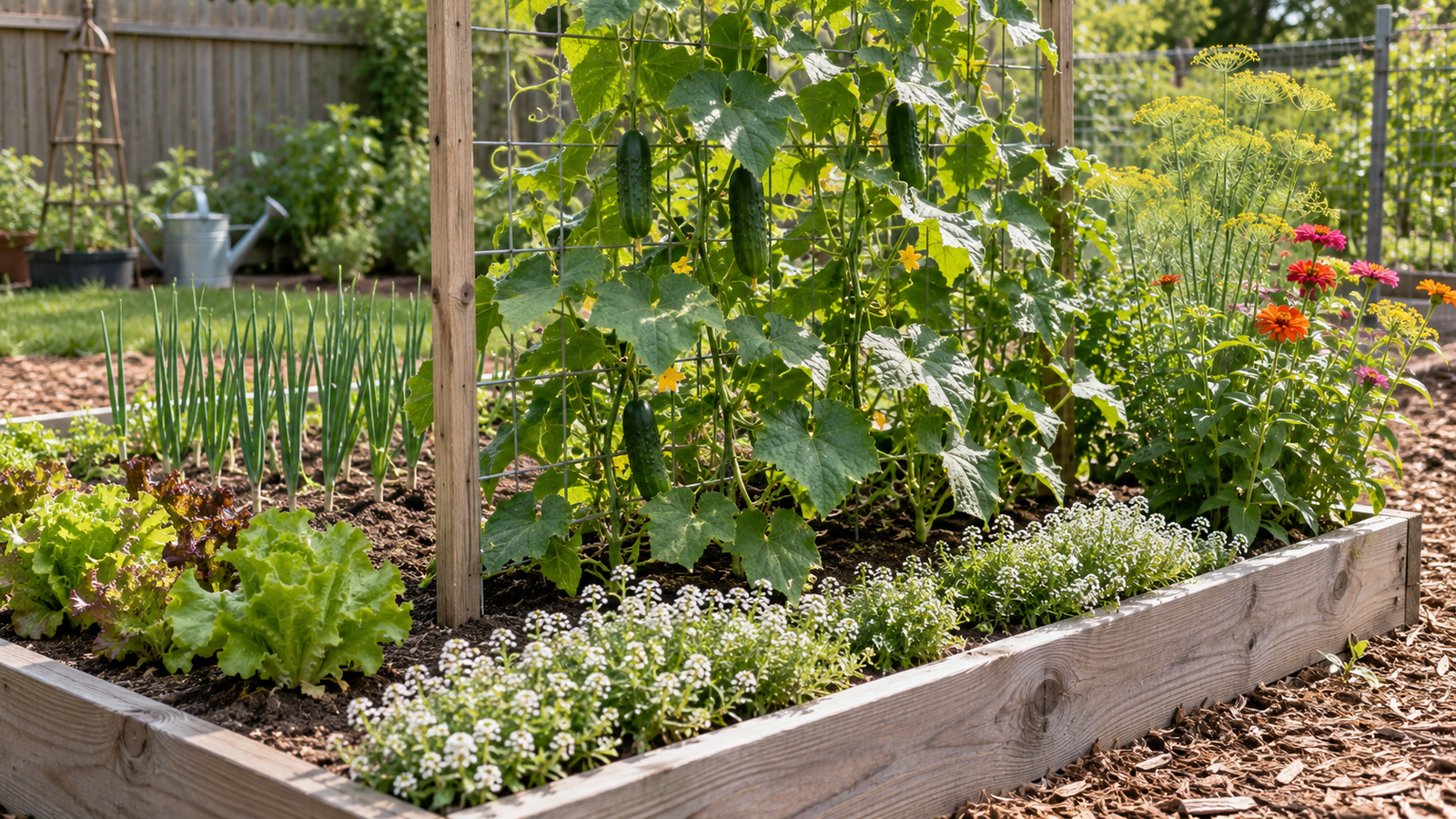
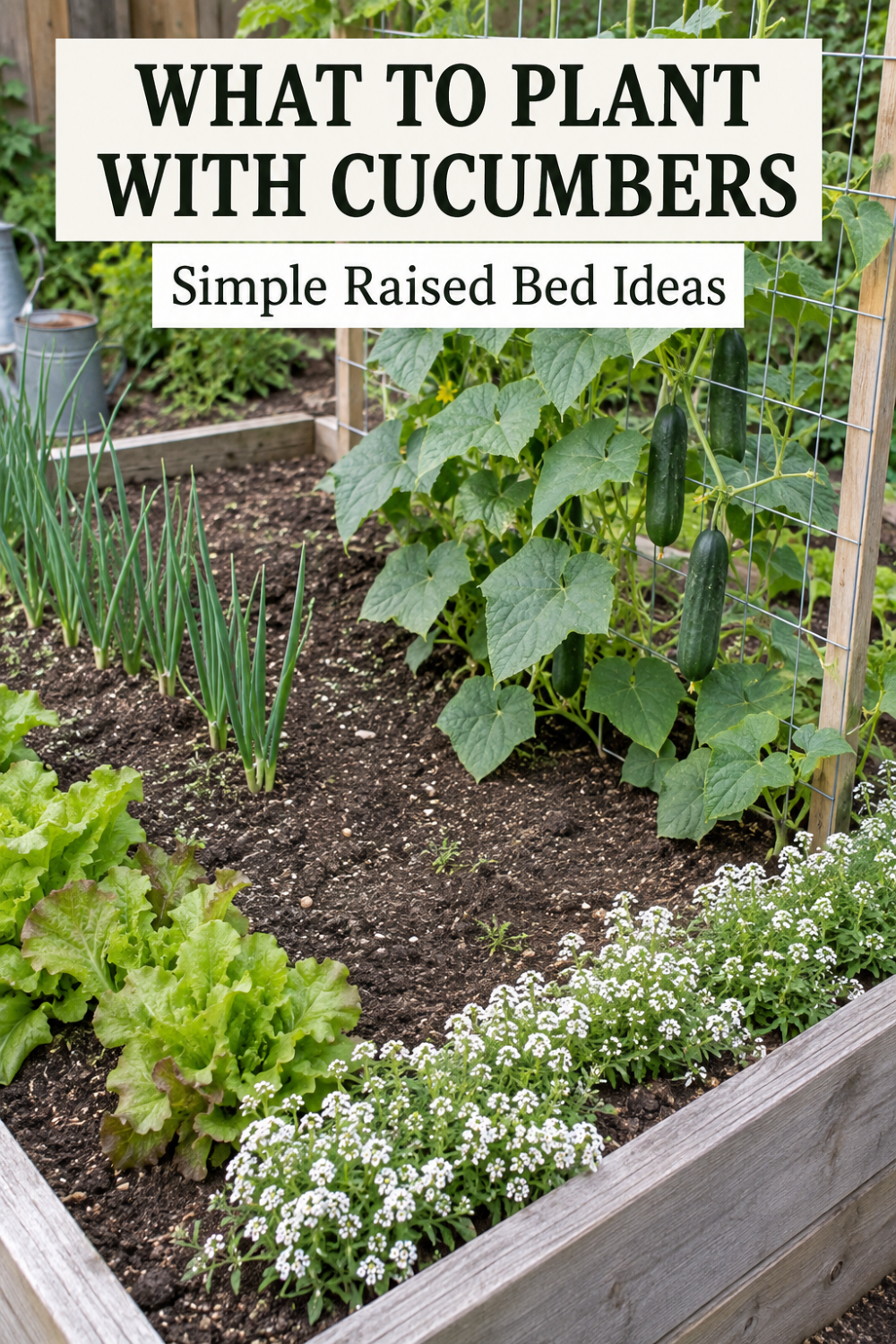
A Simple Cucumber Bed Plan
For a beginner, I would keep the bed uncomplicated.
Put cucumbers on a sturdy trellis.
Leave open soil around the cucumber stems.
Add sweet alyssum along one edge.
Use lettuce in open areas early in the season and harvest it before the cucumber vines become large.
Add a few onions or garlic where there is enough room.
Place larger flowering plants such as zinnias or dill outside the main cucumber root zone.
Keep potatoes elsewhere.
Give pumpkins, melons, and large squash their own space.
Grow mint in a pot.
Put rosemary and sage in a drier part of the garden.
That plan is simple, easy to maintain, and much more useful than trying to follow a long list of mysterious plant friendships.
Frequently Asked Questions
What Is the Worst Plant to Grow with Cucumbers?
For a small raised bed, Irish potatoes are one of the plants I would keep separate. Several Extension companion planting resources list potatoes and cucumbers as incompatible, and potatoes also require digging at harvest, which can disturb cucumber roots.
Can Cucumbers and Potatoes Grow in the Same Garden?
Yes. They do not need to be on opposite sides of the property. I simply recommend keeping them in separate beds or rows so each crop has enough root space and potato harvest does not disturb cucumber vines.
Can Cucumbers and Zucchini Grow Together?
Yes, if there is enough space. Both are cucurbits and share cucumber beetles and several other pests. Zucchini also becomes very large. In a small raised bed, I prefer separating them.
Can Cucumbers and Pumpkins Grow Together?
They can grow in the same garden, but both vines need a lot of space and they share cucumber beetles. Give pumpkins room to spread and keep the cucumber trellis easy to reach.
Can Cucumbers and Melons Be Planted Together?
Yes, but cucumbers and muskmelons are both highly susceptible to bacterial wilt spread by cucumber beetles. If bacterial wilt is common in your area, separating them can make monitoring and crop rotation easier.
Can I Plant Sage with Cucumbers?
You can grow sage nearby. I would not put established sage in the same heavily watered root zone because sage prefers drier, well drained soil.
Can I Plant Rosemary with Cucumbers?
Yes, but a separate pot or drier garden area is usually easier. Rosemary does poorly in wet soil, while cucumbers need consistent moisture.
Can Mint Grow Next to Cucumbers?
Yes, but keep the mint in a container. Mint spreads aggressively through underground stems and can take over a raised bed.
Are Aromatic Herbs Bad for Cucumbers?
Not as a group. Some companion charts repeat that claim, but herbs have very different growth habits and water needs. Judge each herb separately.
Can Cucumbers Grow with Corn?
Yes. Corn is commonly listed as a compatible cucumber crop. Just place it where the mature corn will not shade the cucumber bed.
Can Cucumbers Grow with Sunflowers?
Yes. Sunflowers are also commonly listed as compatible with cucumbers. The main concern is shade and physical space, not a harmful plant interaction.
Final Thoughts
The best way to decide what not to plant with cucumbers is to stop thinking in terms of plant enemies.
Think about what each plant actually does.
Potatoes need soil disturbance at harvest and are awkward in the same small bed.
Pumpkins, squash, and melons share cucumber beetles and take a lot of space.
Sage and rosemary prefer drier growing conditions.
Mint spreads aggressively and can become a permanent problem in a temporary vegetable bed.
Those are understandable reasons to separate plants.
They are much more useful than simply memorizing a chart.
Give cucumbers enough sunlight, steady moisture, a good trellis, access to pollinators, and room for air to move.
Then add only the companions that have a clear purpose.
That is how I would plan a cucumber bed for a beginner.
References
- Virginia Cooperative Extension. Companion Planting in Gardening. Source
- West Virginia University Extension. Companion Planting. Source
- University of California Master Gardeners of Tulare and Kings County. Companion Planting Chart for Home Gardens. Source
- Penn State Extension. Deterring Striped Cucumber Beetles in Organic Cucurbit Production Systems. Source
- University of Minnesota Extension. Cucumber Beetles. Source
- University of Minnesota Extension. Bacterial Wilt of Cucurbits. Source
- University of Maryland Extension. Bacterial Wilt of Vegetables. Source
- Penn State Extension. Growing Herbs in the Garden. Source
- Penn State Extension. Herb Garden Plants: Rosemary. Source
- Illinois Extension. Mint. Source
- University of Minnesota Extension. Growing Herbs in Home Gardens. Source
- Penn State Extension. Cucumber Production. Source