Companion planting can make a vegetable garden more productive, easier to manage, and more welcoming to beneficial insects.
It can also create new problems when the plan comes from a chart instead of the plants growing in front of you.
I have seen gardeners place basil around every tomato, fill cucumber beds with flowers, squeeze onions between peppers, and add marigolds anywhere a pest might appear.
The planting looks impressive in spring.
By midsummer, the bed can become crowded, difficult to water, shaded in the wrong places, and almost impossible to inspect.
The surprising part is that every plant in that bed may have appeared on a “good companion” list.
The problem was not always the plant combination. It was how the combination was used.
These are 11 companion planting mistakes that can quietly work against your garden, plus the practical changes that make mixed planting more useful.
The Short Answer
The most common companion planting mistakes are:
- Following a chart without asking why
- Trying to grow every recommended companion
- Ignoring mature plant size
- Combining plants with different water needs
- Grouping crops that share diseases and pests
- Believing legumes feed neighboring plants immediately
- Expecting one marigold to protect the whole bed
- Letting tall companions steal the sunlight
- Forgetting crop rotation
- Planting aggressive herbs directly in the bed
- Using companion plants instead of basic garden care
Most of these mistakes come from expecting one plant to perform a job that really depends on spacing, timing, variety, climate, and regular garden management.
1. Following a Companion Planting Chart Without Asking Why
A chart can tell you that two plants are “friends” or “enemies.”
It rarely tells you what that relationship is supposed to mean.
Does one plant attract a predator that feeds on a specific pest? Does it flower at the right time? Does it use a different layer of the soil? Is it an early crop that will be harvested before the main crop becomes large?
Or is the pairing simply repeated because it appeared in an older gardening book?
University of Minnesota Extension notes that some companion planting practices are supported by research while the origins of other recommendations are difficult to trace.
That distinction matters.
A chart may list basil as a good companion for tomatoes, but that does not prove basil improves tomato flavor. It may list fennel as bad for nearly everything, even though laboratory tests with concentrated extracts do not automatically prove that a living fennel plant damages a vegetable in normal garden soil.
What to Do Instead
Ask what job the companion plant will perform.
Choose it for a clear reason such as insect habitat, temporary soil cover, efficient use of vertical space, or an additional edible harvest.
Our guide to companion planting myths and facts explains why this question is more useful than memorizing good and bad pairings.
2. Trying to Grow Every Recommended Companion
A list titled “nine best companions for cucumbers” does not mean all nine plants belong around one cucumber.
That sounds obvious, but it is one of the easiest mistakes to make.
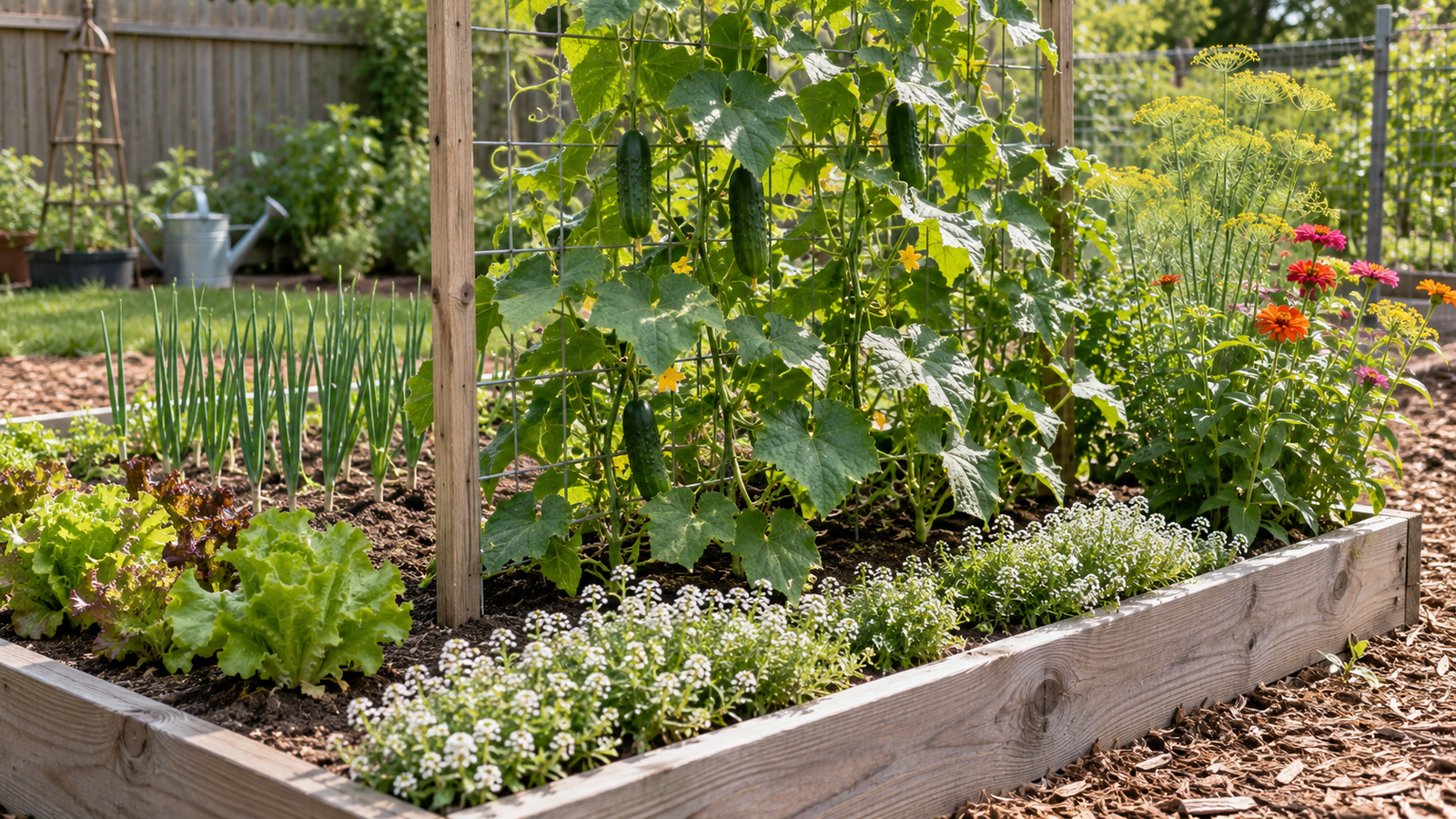
A gardener reads that cucumbers can grow with sweet alyssum, dill, zinnias, lettuce, onions, garlic, red clover, basil, and marigolds. Every choice seems useful, so several of each go into the same bed.
The cucumber still needs room for its roots, access to the trellis, steady water, and enough open soil around the stem.
When the companion plants fill every gap, the bed becomes harder to maintain than a simple cucumber planting.
What to Do Instead
Choose two or three companions that solve specific problems.
For example, a cucumber bed might use sweet alyssum along one edge for flowers, lettuce as an early-season crop, and a few onions where there is open soil.
That is enough.
For a practical example, see our guide to the best companion plants for cucumbers. The value comes from choosing the right plant for the available space, not collecting the entire list.
3. Planning for Transplant Size Instead of Mature Size
A young zucchini plant looks harmless.
A young tomato leaves a wide circle of bare soil around its small stem.
A sunflower seedling occupies almost no visible space.
Then summer arrives.
The zucchini spreads across the path. The tomato fills its cage. The sunflower produces a broad canopy and a large root system. The companions that looked perfectly spaced in May begin touching, shading, and competing in July.
Dense growth can reduce airflow and make leaves stay wet longer after rain or irrigation. It can also hide insect damage and early disease symptoms.
What to Do Instead
Use the mature width and height on the seed packet or plant label.
Sketch the bed using those measurements before planting. Leave access to the main crop for watering, pruning, tying, and harvesting.
Visible soil in spring is not wasted space. It is room reserved for mature plants.
4. Combining Plants with Opposite Water Needs
Two plants can look attractive together and still be poor partners in the same root zone.
Cucumbers need consistent moisture while flowering and producing fruit. Established rosemary and sage prefer soil that drains quickly and is allowed to dry more between waterings.
If you water for the cucumber, the Mediterranean herb may sit in soil that is too wet.
If you water for the rosemary, the cucumber may become stressed and produce poorly.
The same problem appears when a shallow-rooted, moisture-loving crop is packed beside a plant that prefers a drier permanent bed.
What to Do Instead
Group plants by irrigation needs as well as companion reputation.
Grow rosemary, sage, and thyme in a drier herb bed or in containers near the vegetable garden. They can still provide flowers and culinary harvests without sharing the exact cucumber root zone.
This is one reason our guide to what not to plant with cucumbers separates practical incompatibility from claims about plants harming one another.
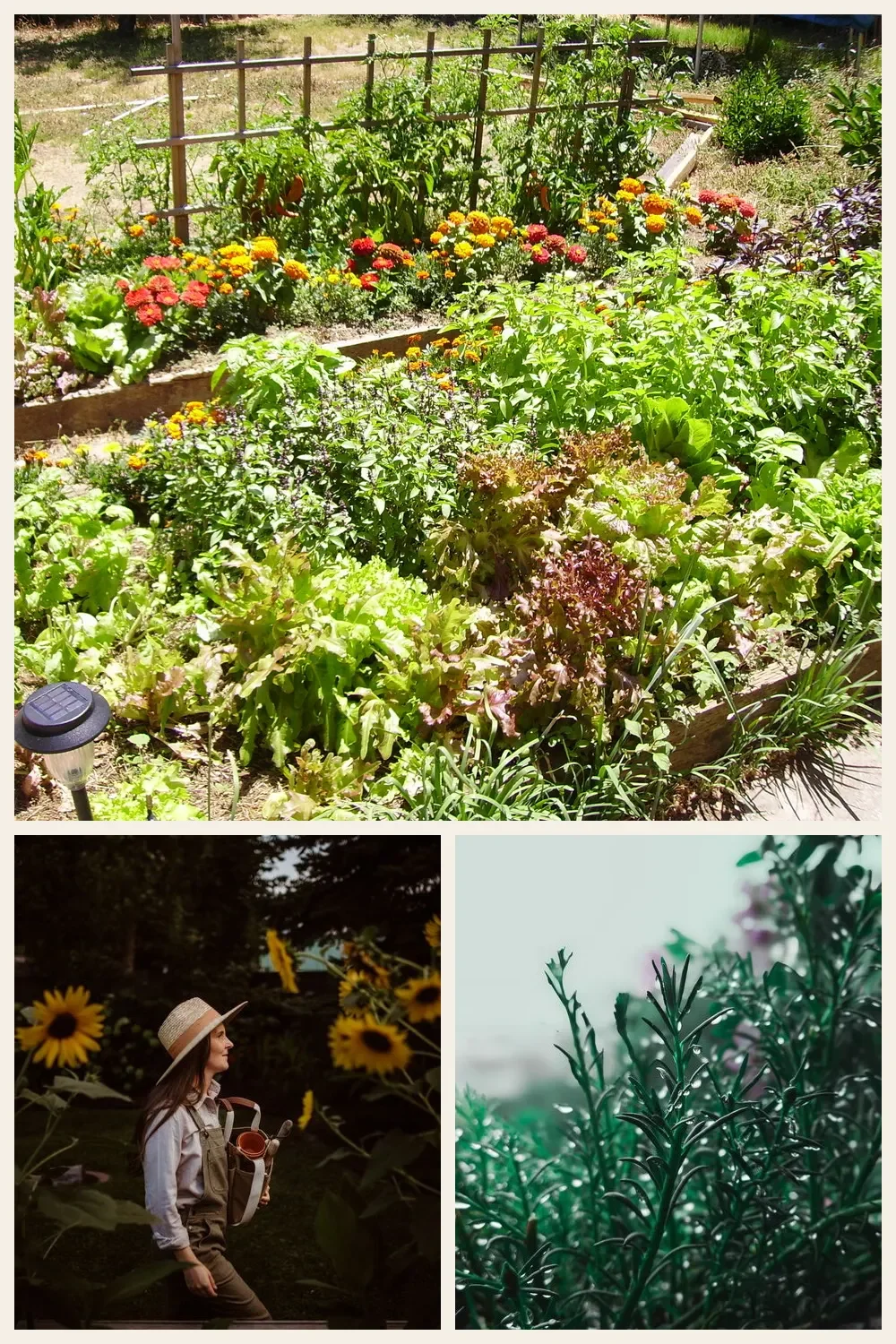
5. Grouping Crops That Share the Same Problems
Growing related vegetables together can create a large target for insects and diseases that prefer that plant family.
Cucumbers, pumpkins, melons, and squash are all cucurbits. They may share cucumber beetles and several diseases.
Tomatoes, peppers, eggplants, potatoes, tomatillos, and ground cherries belong to the nightshade family. They may share diseases, including some bacterial, fungal, and soilborne problems.
None of this means related plants can never share a garden.
The mistake is filling every available bed with the same family and assuming that plant diversity has been achieved because the crop names are different.
What to Do Instead
Count plant families when you plan the garden.
Leave enough space to monitor each crop, and avoid placing every member of one family in every bed. If disease or pest pressure has been serious, separation becomes more important.
Our articles on plants to keep away from tomatoes and what not to plant with peppers show how family relationships affect disease management without turning related crops into forbidden neighbors.
6. Believing Beans Feed Their Neighbors Immediately
Beans, peas, and clover work with bacteria that can convert atmospheric nitrogen into forms used in the plant system.
That fact is real.
The common companion planting explanation is often misleading.
A living bean plant does not continuously hand large amounts of free nitrogen to the tomato or cucumber growing beside it. Much of the nitrogen remains in the legume roots and plant tissue.
University of Minnesota Extension explains that the nitrogen becomes available to other plants when the legumes die and their tissue breaks down.
Meanwhile, the living bean is still using water, light, root space, and other nutrients.
What to Do Instead
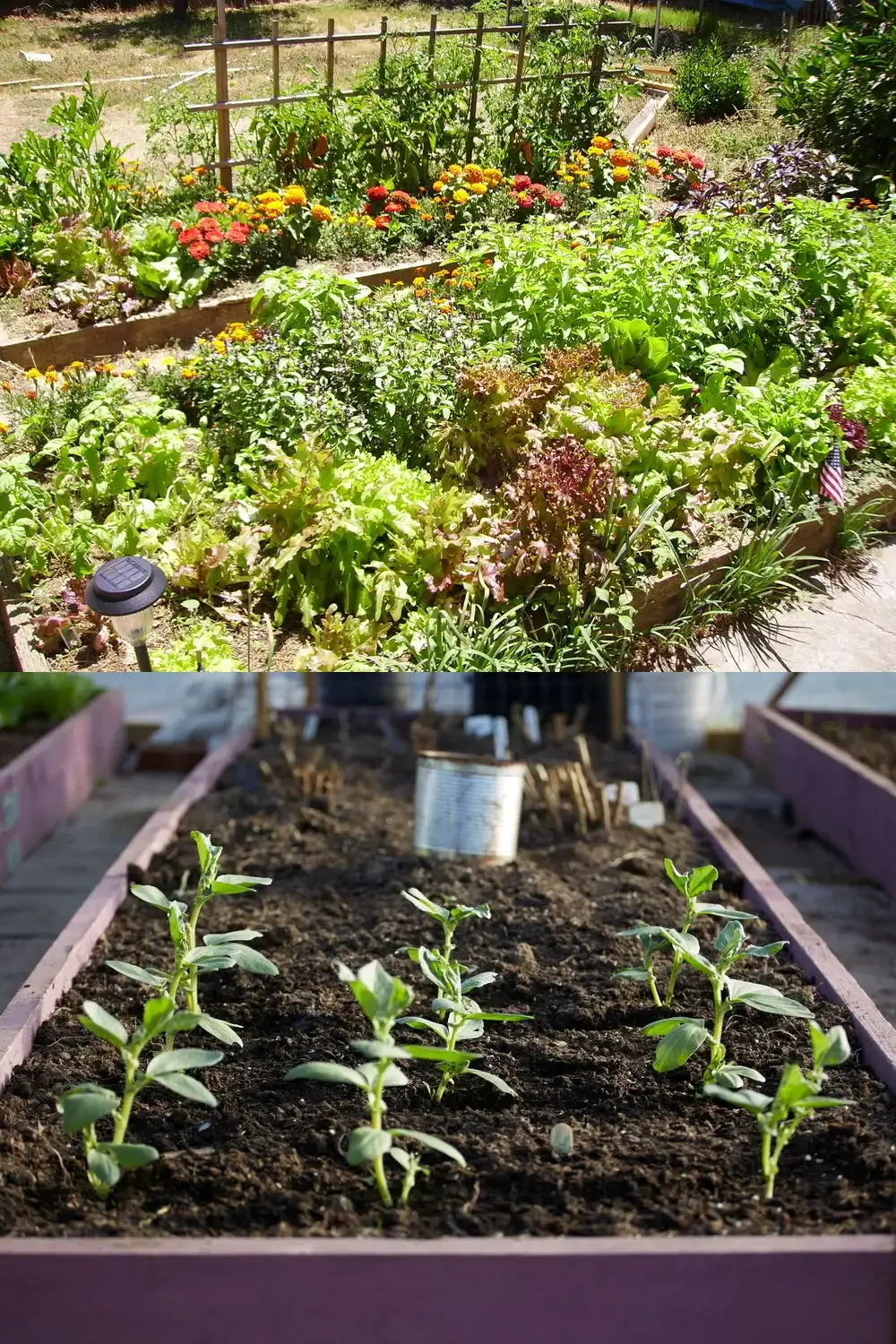
Grow beans because you want the bean harvest or because the planting system makes efficient use of space.
Use legumes as part of a cover crop and rotation plan when you want a more dependable soil-building benefit.
Do not reduce fertilizer or compost for a hungry crop simply because one bean plant is growing nearby.
7. Expecting One Marigold to Protect the Entire Bed
Marigolds may be the most overworked plants in companion gardening.
They are expected to repel aphids, whiteflies, beetles, nematodes, rabbits, and almost anything else a gardener does not want.
The real benefits are more specific.
Marigold flowers can add diversity and provide resources for insects. Certain French marigold cultivars can suppress particular root-knot nematodes when they are grown densely enough and for long enough in the affected soil.
That is not the same as placing one flower beside a tomato and creating complete protection.
What to Do Instead
Use compact marigolds as flowering edge plants.
If nematodes are the target, identify the nematode first and use a tested marigold species, cultivar, and planting method. Treat the marigold as one part of pest management, not a universal pesticide.
Our guide to companion plants for natural pest control explains why flowers work best as habitat rather than magic shields.
8. Putting Tall Plants Where They Steal the Sun
Sunflowers and corn can be useful in a mixed garden.
They can provide vertical structure, flowers, wind protection, and habitat for beneficial insects.
They can also cast a wide shadow across vegetables that need full sun.
A pin or chart may say that cucumbers can climb sunflowers or that a sunflower border helps peppers. The recommendation only works when the mature plants are positioned correctly.
A pepper planted on the shaded side of a dense sunflower row may produce fewer flowers and fruit, even though sunflower appears on a “good companion” list.
What to Do Instead
Track the direction of the sun through the garden.
In the Northern Hemisphere, tall plants are often safer on the north side of a bed, but nearby buildings, fences, and seasonal sun angles can change the answer.
Use sunflowers as a separate border instead of squeezing them between smaller vegetables.
9. Forgetting Crop Rotation Because the Bed Looks Diverse
A bed containing tomatoes, peppers, basil, marigolds, and onions looks diverse.
From a rotation perspective, the main crops may still be almost entirely nightshades.
If tomatoes grow in the bed this year and peppers replace them next year, the crop name changed but the plant family did not.
University of Minnesota Extension recommends placing crops where no member of the same plant family has grown for two to four years when disease management requires rotation.
Raised beds can make this easier when the garden has several distinct planting areas.
What to Do Instead
Keep a simple garden map.
Record the main crop families in each bed, not every small flower or herb. Rotate the family whenever the garden has enough space to do it.
If rotation is impossible, use clean plants, remove diseased residue, improve airflow, avoid splashing soil onto leaves, and monitor problems early.
10. Planting Aggressive Herbs Directly in the Vegetable Bed
Mint appears on many companion planting lists because its flowers and scent seem useful.
The underground growth is the part beginners often discover too late.
Many mints spread through creeping stems below the soil. Once those stems move through the vegetable bed, removing the plant without disturbing crop roots becomes difficult.
A temporary annual bed and an aggressive perennial are often a poor management combination.
The same caution applies to any herb that spreads quickly in your climate.
What to Do Instead
Grow mint in a container beside the garden.
You keep the leaves, fragrance, and flowers without allowing the roots to take control of the rotation bed.
Check the growth habit of every unfamiliar herb before planting it directly in the ground.
11. Using Companion Plants Instead of Basic Garden Care
This is the mistake that causes the most disappointment.
A gardener adds basil, marigolds, nasturtiums, and onions around a tomato, then expects the combination to prevent every problem.
The tomato still needs healthy soil, correct spacing, suitable support, consistent water, and regular inspection.
Companion plants cannot repair poor drainage. They cannot cure an infected plant. They cannot replace crop rotation, remove a caterpillar already inside a fruit, or make a sun-loving crop productive in deep shade.
University of Minnesota Extension recommends basic disease-prevention practices including healthy transplants, crop rotation, proper spacing, mulching, suitable watering, early inspection, and removing infected material.
What to Do Instead
Build the garden around the main crop first.
Meet its needs for light, soil, water, temperature, and space. Add companion plants only after those basics are covered.
A useful companion improves a good plan. It does not rescue a bad one.
A Better Way to Plan Companion Planting
You do not need a complicated chart.
Start with five questions:
- What is the main crop?
- How large will every plant become?
- Do the plants need similar water and sunlight?
- What specific job will the companion perform?
- Will the combination make next year's crop rotation harder?
Then choose the smallest number of companions that accomplish the goal.
If aphids are common, add accessible flowers for hoverflies and other beneficial insects.
If spring soil is empty around a slow-growing summer crop, use lettuce or another short-season vegetable and harvest it before crowding begins.
If the bed needs vertical structure, place the trellis where it will not shade the rest of the garden.
If you need a second edible harvest, choose a compact herb or allium that fits the available root and leaf space.
For examples of combinations built around a clear purpose, see our guide to useful companion planting combinations.
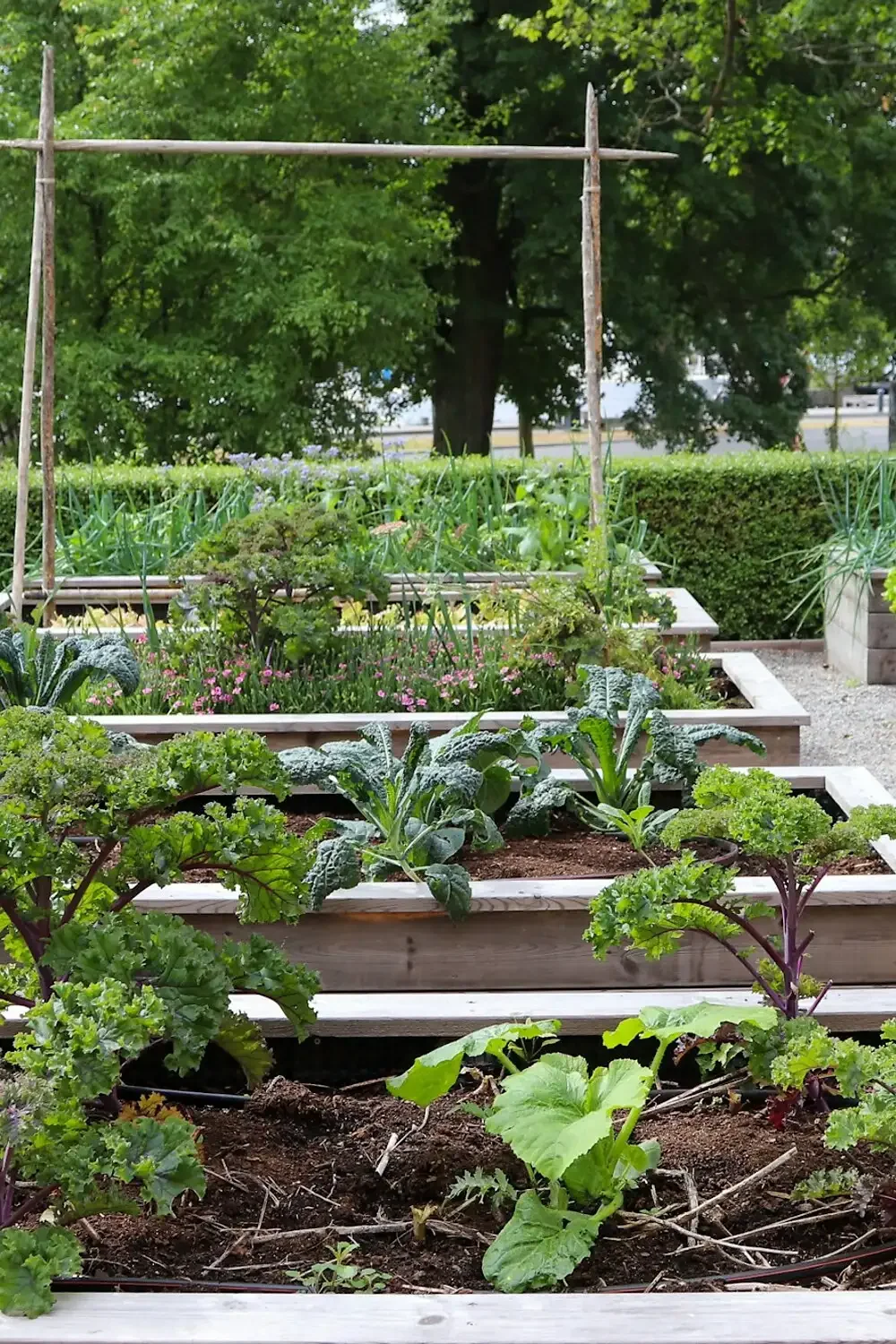
A Simple Raised Bed Example
Imagine a raised bed with tomatoes as the main crop.
Place the tomatoes at their full recommended spacing and install the supports before the roots spread.
Add sweet alyssum along one edge for low flowers. Grow lettuce in open spring areas and harvest it before the tomatoes fill their cages. Add one or two basil plants where they will still receive light.
Stop there.
Do not add a zucchini, a pumpkin vine, mint, four marigolds around every tomato, pole beans on the tomato cage, and a sunflower in the middle simply because each plant appears on a companion list.
A simple plan gives every plant enough room to perform the job you chose it for.
For tomato-specific choices, use our evidence-aware guide to the best companion plants for tomatoes.
Frequently Asked Questions
Can Companion Planting Hurt a Garden?
Yes, when too many plants create crowding, shade, water competition, poor airflow, or difficult crop rotation. The problem is usually the layout and management rather than a mysterious conflict between plants.
What Is the Biggest Companion Planting Mistake?
The biggest mistake is following a chart without understanding the reason for each pairing. A plant that works in one layout may become a problem when it is too dense, too tall, planted at the wrong time, or given the wrong amount of water.
How Many Companion Plants Should I Use?
There is no fixed number. In a small raised bed, two or three carefully selected companions are usually easier to manage than a large collection. Leave enough room for the main crop at maturity.
Do Marigolds Keep All Pests Away?
No. Marigolds add flowers and plant diversity, and certain types can suppress specific root-knot nematodes under the right planting conditions. One marigold does not protect an entire vegetable bed from every pest.
Do Beans Give Nitrogen to Nearby Vegetables?
Not in the simple way often described. Much of the fixed nitrogen stays in the living legume. More becomes available to following crops after roots and plant residue break down.
Can I Plant Vegetables from the Same Family Together?
Yes, but related vegetables may share pests and diseases. Grouping them also affects crop rotation. Use good spacing and avoid filling every garden bed with the same plant family.
Are Companion Planting Charts Useless?
No. A chart can give you ideas and remind you of possible combinations. Treat it as a starting point, then check mature size, water needs, timing, evidence, and the specific problem you want the companion to solve.
Final Thoughts
Companion planting works best when it is practical.
The most successful mixed garden is not the one with the greatest number of different plants.
It is the garden where every plant has enough sunlight, root space, water, and access—and where every companion has a clear reason for being there.
Use charts for ideas, not rules.
Plan for mature size. Match water needs. Respect plant families. Rotate crops when possible. Give flowers time and space to support beneficial insects, but do not expect them to replace basic care.
When you do that, companion planting becomes a useful garden strategy instead of another source of crowding and disappointment.
References
- University of Minnesota Extension: Companion Planting in Home Gardens
- University of Minnesota Extension: Promote Healthy Soil in Your Garden
- University of Minnesota Extension: Managing Plant Diseases in the Home Garden
- University of Minnesota Extension: Raised Bed Gardens
- University of Minnesota Extension: Cover Crop Selection for Vegetable Growers
- Penn State Extension: Herbs Make Good Plant Partners and Companions
- University of Florida IFAS Extension: Intercropping, Crop Diversity and Pest Management
- Xerces Society: Conservation Biological Control and Insectary Plantings